Tartaria, Tesla, and the Cabbage Patch Kids
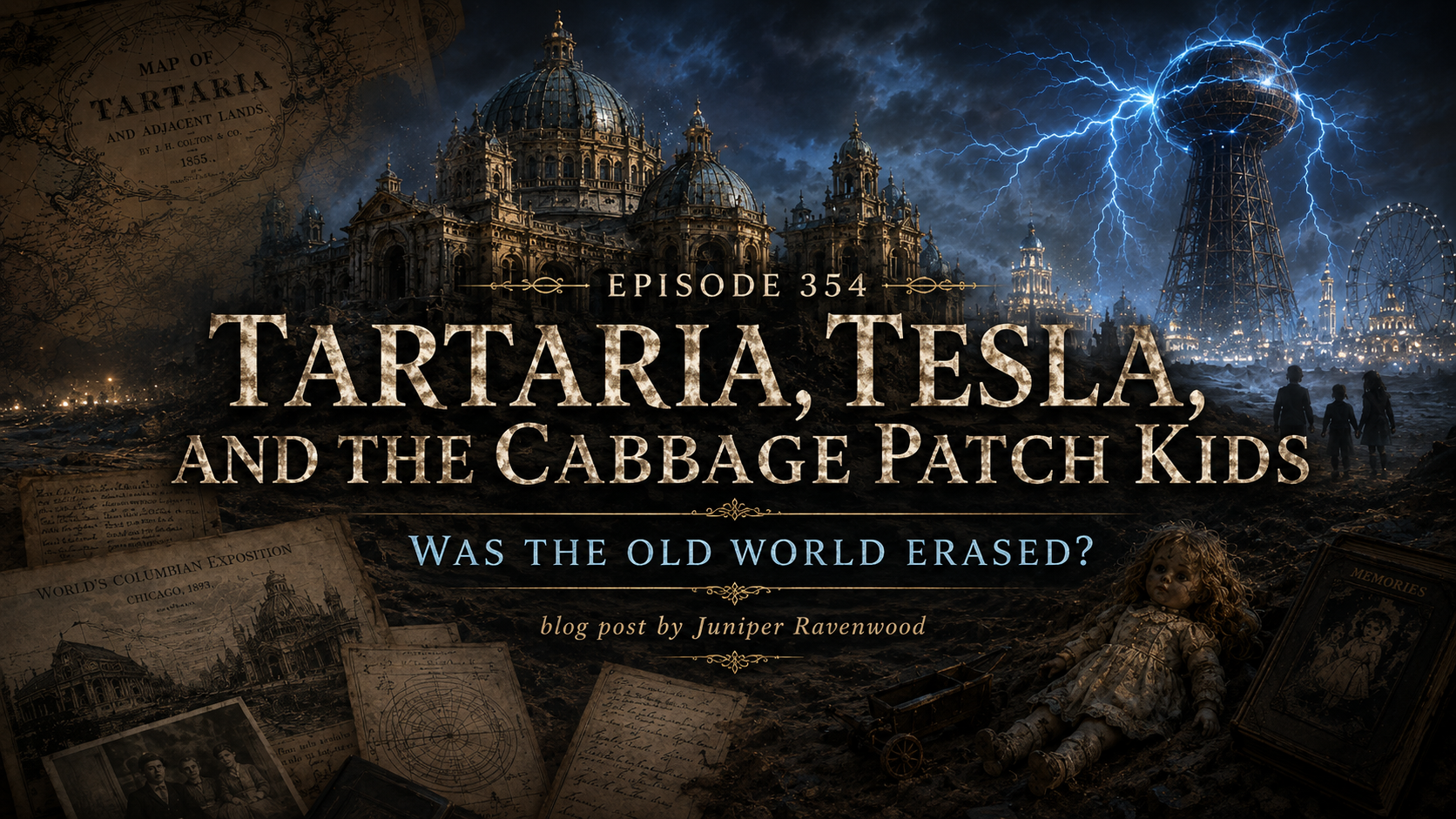
Tartaria, Tesla, and the Cabbage Patch Kids: Was the Old World Erased?
Author: Juniper Ravenwood
The Old World Beneath Our Feet 🏛️
There are certain buildings that feel wrong in the best possible way. You know the ones. The old courthouse downtown with stonework so detailed it seems carved by a civilization with more time, more skill, and maybe more secrets than we were taught to expect. The train station with ceilings high enough to swallow sound. The abandoned asylum with arched windows and staircases that seem to descend into a version of history no one bothered to explain.
In Episode 354 of The Shadow Frequency, we step directly into that strange feeling. The episode, Tartaria, Tesla, and the Cabbage Patch Kids: Was the Old World Erased?, explores one of the most sprawling and eerie theories in alternative history: the idea that the 19th century may not have been the beginning of the modern world, but the aftermath of something older. 🌫️
Tartaria: Map Label or Missing Empire? 🗺️
Historically, names like Tartary and Tartaria appeared on old maps as broad labels for regions of Asia that European mapmakers often poorly understood. That part is real. But in the modern Tartaria mythos, the name grows into something much bigger — a supposed lost civilization whose influence may have stretched across continents.
Believers point to old architecture, strange map labels, unexplained construction timelines, buried lower floors, and repeating design patterns across countries. Domes, spires, towers, columns, massive windows, copper roofs, and ornate masonry become more than decoration. In this theory, they become clues. Maybe even remnants of a forgotten technology. ⚡
The Mud Flood and the Buried Windows 🌊
One of the creepiest branches of the theory is the mud flood idea. Supporters point to old buildings with basement windows below street level, doors that open into sidewalks, and photographs of city streets that appear swallowed by mud or debris.
Mainstream explanations include street grading, flood control, rebuilding after fires, and ordinary changes in urban planning. But the Tartarian interpretation asks a darker question: what if these are not just construction quirks? What if portions of the old world were literally buried, and the new world simply paved over them?
That image is hard to shake — a civilization not erased by fire alone, but entombed floor by floor. 🕯️
World’s Fairs: Progress or Funeral? 🎡
The world’s fairs of the 19th and early 20th centuries were real spectacles of architecture, industry, empire, and electricity. But they also feel strangely dreamlike. Massive temporary cities appeared, dazzled millions, and then many of their buildings were demolished, burned, or dismantled.
In the episode, we explore the possibility that these fairs were not only celebrations of progress, but symbolic handoffs. Were people being shown the future? Or were they unknowingly walking through the remains of the past?
The 1893 World’s Columbian Exposition in Chicago — the White City — becomes especially haunting in this context. A glowing city of domes, canals, lights, and classical architecture rising from the earth, only to vanish like a stage set after the curtain falls. 👁️
Tesla and the Ghost of Free Energy ⚡
Nikola Tesla fits into this mystery almost too perfectly. His real accomplishments were extraordinary enough: alternating current systems, motors, wireless experimentation, high-voltage demonstrations, and Wardenclyffe Tower.
But in the Tartaria-adjacent version of history, Tesla becomes more than an inventor. He becomes a man trying to reconnect the modern world to something older. Maybe he was not inventing the future. Maybe he was rediscovering the past.
That is the power of the Tesla legend. He already feels like a figure who stood with one foot in science and one foot in myth. In this episode, he becomes the lightning rod between buried architecture, atmospheric energy, and the idea that humanity once understood power in a way we have since forgotten.
The Cabbage Patch Kids Question 🚂
The most unsettling thread may be the “Cabbage Patch Kids” idea. Historically, the orphan train movement relocated large numbers of orphaned, abandoned, and homeless children from cities to rural communities between the mid-1800s and early 1900s.
That history is already emotional and complicated. But alternative theorists ask whether these children could represent something even darker — a population reclassified after a reset, given new homes, new names, and new identities.
This does not mean the theory is proven. But it does explain why the subject has such emotional force. The architecture may be grand, the maps may be mysterious, and Tesla may be electrifying — but the children in the records bring the mystery down to the human level.
Why This Theory Endures 🌒
The Tartaria theory endures because it connects things that already feel strange. Old buildings that seem too magnificent. World’s fairs that vanished too quickly. Fires, floods, and rebuilds. Tesla’s interrupted dream. Children moved across the country. Maps with names that no longer belong to the world we know.
Maybe the old world was erased. Maybe it simply became ordinary. Maybe the most effective cover-up is not hiding the evidence, but teaching people to walk past it without asking what they are seeing.
And that is where The Shadow Frequency lives — between the archive and the campfire, where the documents say one thing, but the stones whisper something else. 🏛️⚡
— Juniper Ravenwood

Producer, The Shadow Frequency
Juniper Ravenwood is the heart and soul behind the production of The Shadow Frequency podcast, bringing her passion for the paranormal and storytelling to every episode. Born in the wide-open plains of South Dakota, Juniper grew up surrounded by tales of mystery and the unexplained, which sparked her fascination with the eerie unknown. With a deep love for podcasting and the boundless world of the internet, she crafts each episode with a blend of spooky atmosphere and meticulous care, ensuring listeners are drawn into the shadows. As the producer, Juniper not only manages the show’s chilling vibe but also connects with fans through the Mailbag segment and the podcast’s vibrant online community. When she’s not diving into creepy stories or exploring the digital realm, you can find her chasing new paranormal mysteries or dreaming up ways to make The Shadow Frequency even spookier. Connect with Juniper and the show at shadowfrequencypodcast.com or shadowpodcast@protonmail.com!
Lost Cities Beneath the Amazon Canopy


 RSS Feed