The Kalahari UFO Crash
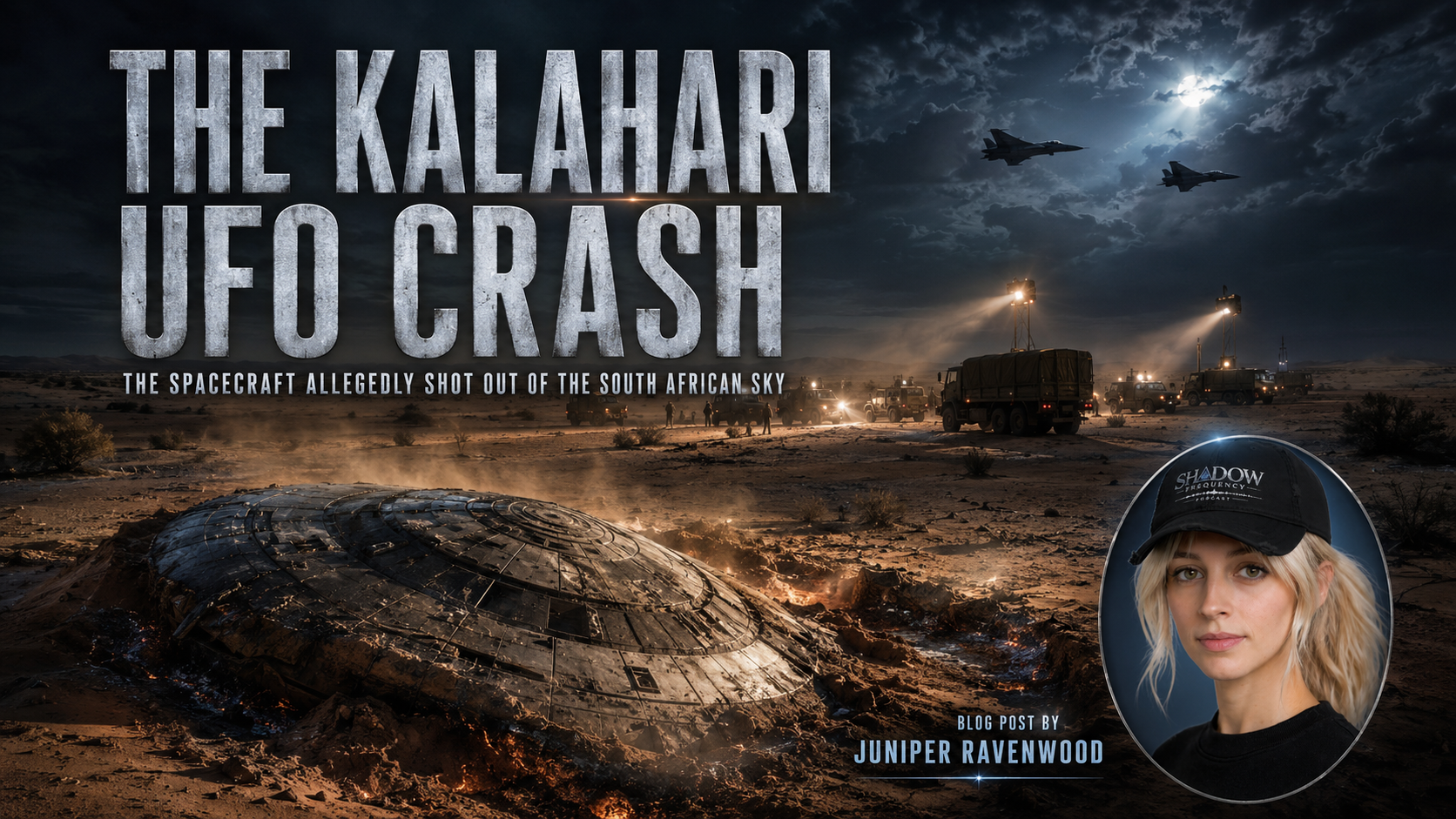
The Kalahari UFO Crash: Secret Recovery or Desert-Born Hoax? 🛸🏜️
By Juniper Ravenwood
A Signal Over the Desert 📡
The Kalahari is the sort of place where a secret could disappear without leaving so much as an echo. Its distances are immense, its night sky feels endless, and its red earth can swallow tracks almost as quickly as the wind creates them. That lonely setting forms the backdrop for one of the strangest—and most disputed—UFO crash stories ever to emerge from southern Africa.
The account begins on May 7, 1989, when an unidentified object allegedly entered South African airspace at tremendous speed. Radar operators could not identify it, and attempts at communication reportedly went unanswered. Two South African Air Force Mirage fighters were supposedly ordered to intercept the intruder as it moved toward the Kalahari region near Botswana.
This is where an unusual aerial encounter becomes something far more disturbing. According to the story, one of the pilots fired an experimental weapon called Thor 2. The object lost altitude and came down in the desert. If that happened, this was not simply a UFO sighting. It was an act of confrontation—and perhaps humanity’s first hostile exchange with an unknown intelligence. ⚡
The Alleged Recovery 👽
The scene described by later sources is almost impossibly cinematic. A polished silver disc rested in a scar of scorched earth. The surrounding sand and stone had supposedly fused into a glasslike crust. Electronic instruments faltered near the wreckage, and the craft appeared to have no familiar seams, rivets, wings, or engines.
Recovery personnel allegedly forced their way inside and found two living humanoid beings. They were described as four to five feet tall, with thin bodies, oversized heads, enormous dark eyes, gray-blue skin, and three-fingered hands. One reportedly scratched a member of the recovery team while being restrained.
The craft and its occupants were then said to have vanished into military custody. Some versions connect the recovery with a hidden installation known as Camp 13. Others claim that Operation Silver Diamond transferred the wreckage and both beings to American authorities at Wright-Patterson Air Force Base. A further rumor suggests that one occupant remained behind in South Africa.
There are no publicly verified photographs of the craft, no confirmed radar tapes, and no living witness whose testimony establishes the recovery beyond reasonable doubt. What remains is a story—and a set of documents that caused the entire mystery to turn inward.
When the Paper Trail Became the Mystery 📁
British UFO investigator Tony Dodd received material associated with a purported operation called Black Horse. Dodd, a former police officer, treated the story seriously and pursued contacts he believed were connected to South African intelligence. James van Greunen, the man most closely associated with the papers, signed an affidavit supporting the account and claimed that revealing it was a duty to humanity.
Yet African UFO researcher Cynthia Hind examined the supposed official material with a far more skeptical eye. Her 1993 article, “Anatomy of a Hoax,” identified spelling errors, unusual terminology, inconsistent dates, questionable formatting, geographic problems, and a lack of verifiable personnel. Most damaging of all, van Greunen eventually acknowledged that some of the material had been fabricated or reconstructed.
By normal evidentiary standards, that is devastating. A document created after the fact cannot authenticate the event it describes. Once false evidence enters a case, every other claim becomes contaminated by association. 🕵️♀️
Could False Evidence Hide a True Event? 🤔
Van Greunen did not completely abandon the story. He maintained that the underlying incident was real and suggested that documents had been recreated because authentic records could not be removed from secure channels. That explanation creates the Kalahari case’s most persistent question: Can a true secret reach the public inside a false container?
It is certainly possible for a hoaxer to rescue a failing story by claiming access to evidence that can never be produced. It is also true that late-1980s South Africa operated behind deep layers of military secrecy. Sanctions, regional conflict, weapons development, and the apartheid government’s tightly controlled security apparatus created an environment in which extraordinary rumors could thrive—and in which real classified activity could remain hidden.
But a secretive setting is not proof. Neither is an anonymous warning, a secondhand intelligence contact, or an official-looking page. Curiosity asks us to consider possibilities; responsible investigation asks us to recognize when the evidence cannot carry the weight of the claim.
What May Be Buried in the Sand 🌌
The Kalahari UFO crash endures because it offers three mysteries at once. Perhaps an unknown craft was genuinely intercepted and its occupants disappeared into a military program. Perhaps the entire incident was an elaborate fabrication constructed from Cold War secrecy and familiar Roswell imagery. Or perhaps a smaller, real event was wrapped in invented documents until the truth became impossible to separate from the mythology.
That final possibility may be the most unsettling. A hoax does more than create belief; it can also manufacture disbelief. If genuine evidence ever surfaced beside the Black Horse papers, would anyone recognize it—or would it be dismissed as one more fragment of the same deception?
The desert has offered no answer. The alleged craft is gone, the survivors exist only in testimony, and the paperwork cannot be trusted. All that remains is an empty stretch of earth and one lingering thought: sometimes the most effective way to hide a secret is to surround it with a story nobody can prove. 🛸
Stay curious, keep questioning, and never mistake an official appearance for verified truth.
Until the next signal,
Juniper Ravenwood 🌙
Producer, The Shadow Frequency

Producer, The Shadow Frequency
Juniper Ravenwood is the heart and soul behind the production of The Shadow Frequency podcast, bringing her passion for the paranormal and storytelling to every episode. Born in the wide-open plains of South Dakota, Juniper grew up surrounded by tales of mystery and the unexplained, which sparked her fascination with the eerie unknown. With a deep love for podcasting and the boundless world of the internet, she crafts each episode with a blend of spooky atmosphere and meticulous care, ensuring listeners are drawn into the shadows. As the producer, Juniper not only manages the show’s chilling vibe but also connects with fans through the Mailbag segment and the podcast’s vibrant online community. When she’s not diving into creepy stories or exploring the digital realm, you can find her chasing new paranormal mysteries or dreaming up ways to make The Shadow Frequency even spookier. Connect with Juniper and the show at shadowfrequencypodcast.com or shadowpodcast@protonmail.com!

Lost Cities Beneath the Amazon Canopy


 RSS Feed