PURSUE: When the Government Opens Its UFO Files
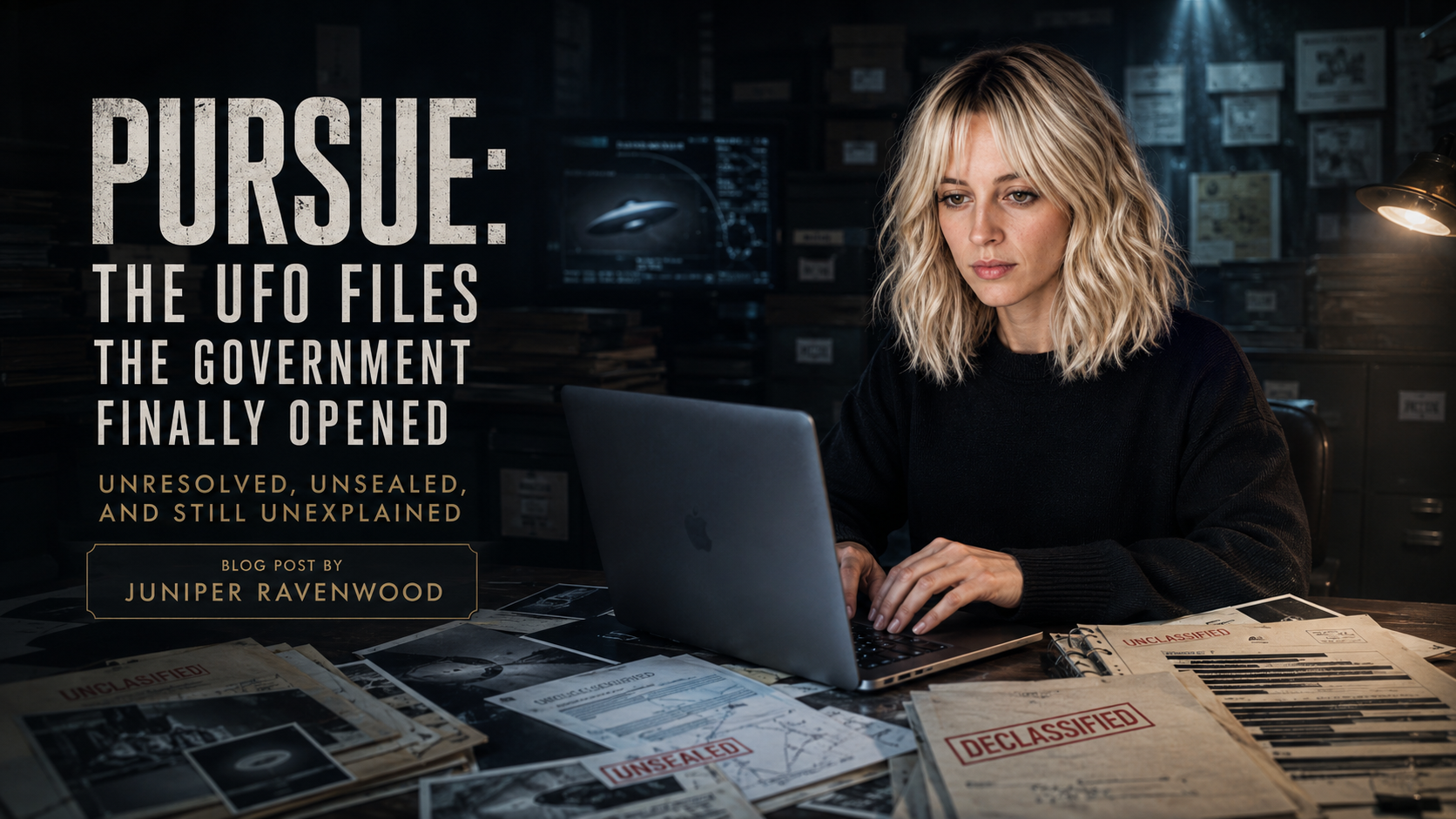
PURSUE: When the Government Opens Its UFO Files
Author: Juniper Ravenwood
🗄️ When the Filing Cabinet Opens
There is something uniquely unsettling about an unsolved mystery stamped with an official seal. A strange light reported by a lone witness may become folklore, but a strange object photographed by a spacecraft, studied by military analysts or discussed by nuclear-age scientists enters a different territory. It becomes part of the historical record—and it begins asking questions long after everyone who first handled the file has left the room.
That is the fascination at the center of PURSUE, the government’s expanding archive of material connected to UFOs, unidentified anomalous phenomena and alleged extraterrestrial life. The collection does not deliver the cinematic disclosure many people imagine when they hear the phrase “government UFO files.” There is no triumphant final page announcing that visitors from another world have arrived. What it offers may be more intriguing: photographs, films, reports, sketches and correspondence that have survived because the available evidence never produced a definitive answer. 🛸
🚀 Three Photographs Above the Earth
One of the archive’s most haunting sequences comes from Space Shuttle Columbia’s STS-80 mission in 1996. Across three photographs, an object appears against the darkness of space and the glowing curve of Earth. Its position and orientation seem to change, yet the images do not provide the distance or scale needed to determine its true size.
That missing information changes everything. A tiny fragment of nearby debris can look like a distant craft. Ice crystals exposed to orbital lighting or disturbed by a thruster can appear to maneuver. At the same time, the lack of range data means the viewer cannot simply dismiss the object by looking at it. We are left with three genuine images from a carefully documented space mission—and a shape that still lacks a final identity. 🌎📷
🎞️ The Cold War Sky Refuses to Stay Quiet
The mystery reaches much farther back than the shuttle era. Films taken over Montana in 1950 and Utah in 1952 were later examined by military photographic specialists. Analysts studied brightness, movement, apparent formation, possible shape and estimated acceleration. Their work did not transform the objects into extraterrestrial vehicles, but neither did it produce a comfortable identification.
Then there were the green fireballs reported near Los Alamos in 1949. The location mattered enormously. Los Alamos stood at the heart of America’s atomic program, so unexplained luminous objects nearby were not merely scientific curiosities. If they were foreign surveillance, the nation faced a security breach. If they were unusual meteors or electrical phenomena, researchers were confronting something poorly understood. And if they belonged to neither category, then some of the most accomplished scientific minds of the era were looking into a sky that had presented them with a completely unfamiliar problem. 💚☢️
📡 Sometimes the Secret Is the Camera
One of the most important lessons in the PURSUE material is that classification does not automatically make an object extraordinary. A blurry image of a balloon, bird or piece of debris may remain secret because the image reveals what a sensitive military camera can detect. Resolution, platform position, collection time and hidden metadata can teach an adversary how a surveillance system works—and how to evade it.
This creates a frustrating paradox. Protecting the sensor may be perfectly reasonable, but removing the metadata can also remove the information researchers need to identify the object. When the image finally becomes public, the mystery may appear greater because its original context is gone. 🔐
⚖️ “Unresolved” Does Not Mean “Alien”
The word unresolved deserves careful handling. It does not describe the object; it describes the evidence. A photograph without distance cannot establish size. A witness statement without supporting data may be sincere but impossible to test. A copied film can lose detail with every generation. A report written decades later may preserve the central mystery while losing the measurements that could have solved it.
That does not make these cases worthless. It makes intellectual honesty essential. We should not use uncertainty as proof of extraterrestrial visitation, but we should not erase uncertainty simply because an ordinary explanation feels likely. The most responsible position is sometimes the least satisfying one: something was observed, the record is incomplete, and we do not currently know what it was. 👁️
🌌 The Most Important File May Still Be Waiting
PURSUE is not a finished archive. Additional records may still be sitting in boxes, passing through review or waiting for someone to decide what can safely be released. Most may eventually point toward balloons, debris, sensor artifacts, astronomical objects or misidentified aircraft. A few may continue resisting every proposed explanation.
That possibility is why these documents matter. They allow us to study not only strange things in the sky, but also the machinery of secrecy, the limitations of observation and the way uncertainty becomes modern folklore. The government has opened the cabinet, but it has not illuminated every corner inside. Somewhere behind the next classification stamp may be an answer—or another beautifully preserved question.
Until next time, keep one eye on the evidence and the other on the sky. 🔭🛸
— Juniper Ravenwood
Producer, The Shadow Frequency

Producer, The Shadow Frequency
Juniper Ravenwood is the heart and soul behind the production of The Shadow Frequency podcast, bringing her passion for the paranormal and storytelling to every episode. Born in the wide-open plains of South Dakota, Juniper grew up surrounded by tales of mystery and the unexplained, which sparked her fascination with the eerie unknown. With a deep love for podcasting and the boundless world of the internet, she crafts each episode with a blend of spooky atmosphere and meticulous care, ensuring listeners are drawn into the shadows. As the producer, Juniper not only manages the show’s chilling vibe but also connects with fans through the Mailbag segment and the podcast’s vibrant online community. When she’s not diving into creepy stories or exploring the digital realm, you can find her chasing new paranormal mysteries or dreaming up ways to make The Shadow Frequency even spookier. Connect with Juniper and the show at shadowfrequencypodcast.com or shadowpodcast@protonmail.com!

Lost Cities Beneath the Amazon Canopy


 RSS Feed