Lost Cities Beneath the Amazon Canopy
🪶 The Lost Cities Beneath the Amazon Canopy: Following the Roads Into Silence
By Juniper Ravenwood
September 7, 2026 | Companion to The Shadow Frequency, Episode 371
🌳 A Forest With Another Story Underneath
There is something wonderfully unsettling about a place that becomes stranger the longer you look at it. At first, you see trees. Then someone hands you a different kind of map, and the ground beneath those trees begins to reveal circles, corners, boundaries, and roads. Suddenly, you are looking at the remains of decisions made by people whose lives unfolded centuries before your own.
That is the feeling at the heart of our latest Shadow Frequency episode. Beneath the Amazon canopy, researchers are recovering traces of a remarkable cultural landscape. What holds my attention is the thought that someone once knew those roads as well as I know the route to our studio.
🔦 The Light That Recovered the Outlines
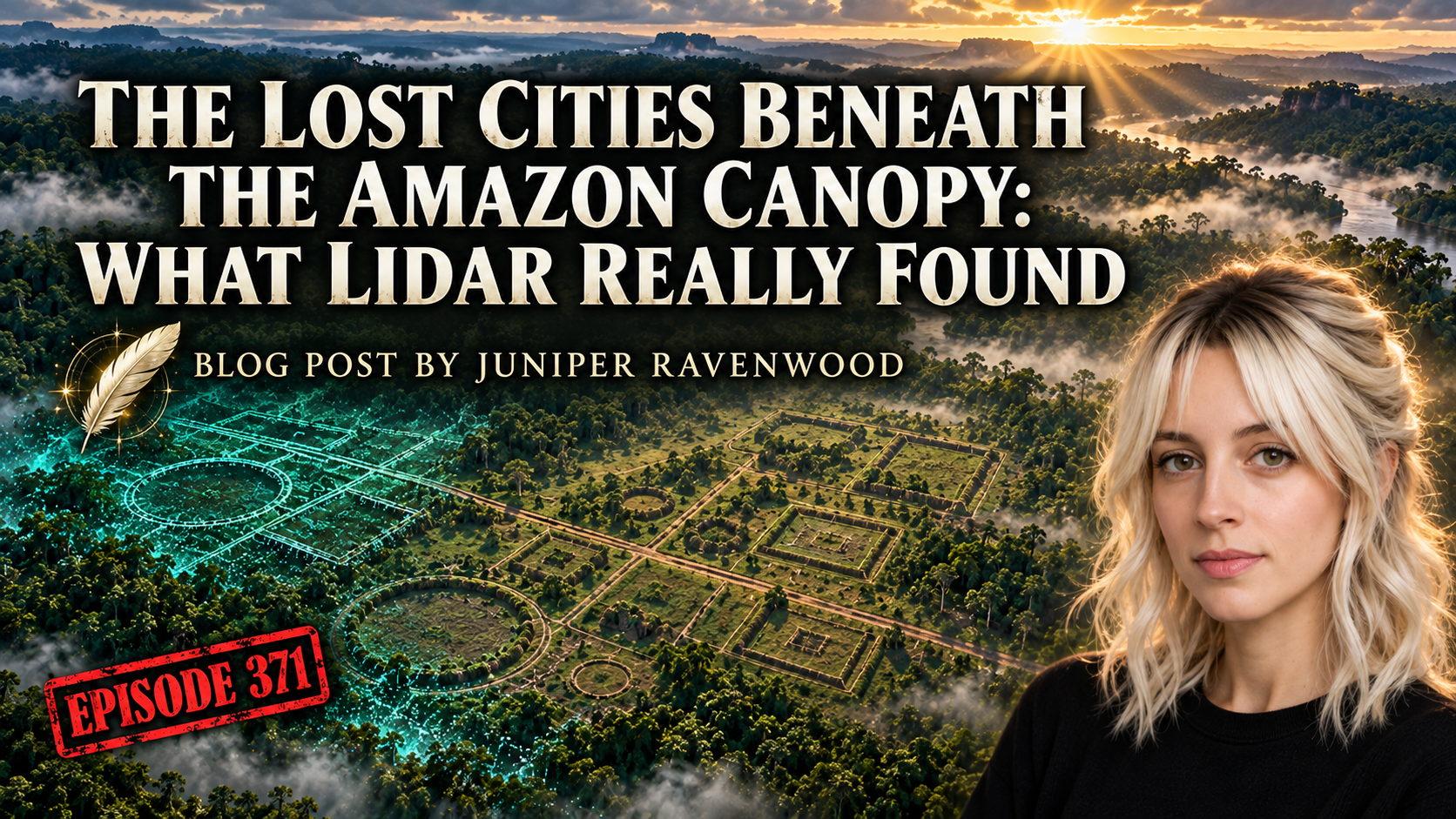
The research discussed in Episode 371 used airborne LiDAR to investigate southwestern Amazonia. Some laser pulses reach the ground through gaps in the vegetation. Their returns help researchers construct a terrain model, revealing features difficult to recognize beneath the canopy.
The 2024 survey documented 432 earthworks, only 36 of which had previously been recorded. That means 396 additional structures entered the archaeological picture. The findings were published in Nature on July 29, 2026. Explore the original study.
Imagine the moment a line on a screen begins to make sense. It has a corner. It belongs to an enclosure. There is an entrance. Your next question almost asks itself: who came through it?
🏛️ The People Who Kept Coming Back
The researchers use Aquiry as a modern scholarly name for a multicultural society associated with these monuments. Many enclosures are interpreted as public, political, and ceremonial centers connected with dispersed communities.
That picture invites us to imagine the preparations for a gathering: food being carried, relatives meeting, stories being exchanged, and children learning how their community understood the world. Those details are an invitation to think about human lives, rather than a reconstruction of one documented ceremony.
Chris made a point in the episode that stayed with me: building something enormous is impressive, but persuading later generations to maintain it tells us that its meaning endured. Whatever brought people together there, it mattered enough to keep the paths open.
👻 Could a Place Hold an Echo?
Here at The Shadow Frequency, that is where another question begins to stir. Could generations of reverence, grief, anticipation, and celebration leave an impression on a place?
I find that possibility compelling. Stand at the entrance to an old gathering space and imagine how many people once paused at the same boundary. How many arrived excited? How many were frightened? How many expected to feel close to someone who had died?
Those are speculative questions about human experience and the unseen. They are not findings established by the LiDAR survey. Still, they give the outlines an emotional weight: a circle in the earth can make us wonder about everyone who once stood inside it.
📊 The Numbers Behind the Headlines
The study’s wider estimates—24,000–30,000 earthworks and a peak population of 1.25–3 million—describe a possible scale far beyond the surveyed structures. They rely on extrapolation and assumptions about how many centers operated together and how many people were associated with them.
Keeping that distinction clear helps us appreciate both the discovery and the questions still open. The directly recorded earthworks already demonstrate extraordinary organization. Further investigation can refine our understanding of the communities behind them.
🌱 The Forest Is Part of the Story
The episode also explores crop cultivation and the management of useful trees, including Brazil nuts and peach palms. Some of the forest’s present character reflects long histories of human interaction with the landscape. Read the University of Helsinki’s research summary.
I love the quiet intimacy of that idea. Someone cared for a productive landscape, and the consequences of those choices continued beyond their lifetime. The forest that conceals an earthwork may also carry another part of its builders’ legacy.
🕯️ The Road That Remains
The great geometric centers appear to have fallen out of use around 850 CE. Later settlements show that people continued living in the wider region, while the reasons for the earlier change remain unresolved.
That leaves me thinking about a familiar road becoming an old road. A gathering place becoming a landmark. A landmark becoming difficult to recognize beneath the trees.
The outline survives. Its full meaning is harder to recover. And somewhere between those two things, an entire world is waiting to be understood.
🎧 Open the File With Us
Join Matt Wilson, Chris Beach, and me for Episode 371: The Lost Cities Beneath the Amazon Canopy—What LiDAR Really Found.
🕒 Runtime: 26m 57s | 📅 Air Date: September 7, 2026
Visit shadowfrequencypodcast.com for the episode, show notes, companion posts, and merchandise. Find us on Facebook: Shadow Frequency Podcast, YouTube: @shadowfrequencypodcast, and TikTok: shadowfrequencypodcast.
Until the next drawer opens, keep a little light beside you. 🕯️
— Juniper Ravenwood 🪶
Producer, The Shadow Frequency
#Archaeology #AncientHistory

Producer, The Shadow Frequency
Juniper Ravenwood is the heart and soul behind the production of The Shadow Frequency podcast, bringing her passion for the paranormal and storytelling to every episode. Born in the wide-open plains of South Dakota, Juniper grew up surrounded by tales of mystery and the unexplained, which sparked her fascination with the eerie unknown. With a deep love for podcasting and the boundless world of the internet, she crafts each episode with a blend of spooky atmosphere and meticulous care, ensuring listeners are drawn into the shadows. As the producer, Juniper not only manages the show’s chilling vibe but also connects with fans through the Mailbag segment and the podcast’s vibrant online community. When she’s not diving into creepy stories or exploring the digital realm, you can find her chasing new paranormal mysteries or dreaming up ways to make The Shadow Frequency even spookier. Connect with Juniper and the show at shadowfrequencypodcast.com or shadowpodcast@protonmail.com!
Frankfort UFO Files



 RSS Feed