The Golden Dawn: When Victorian Magicians Claimed the Rituals Worked
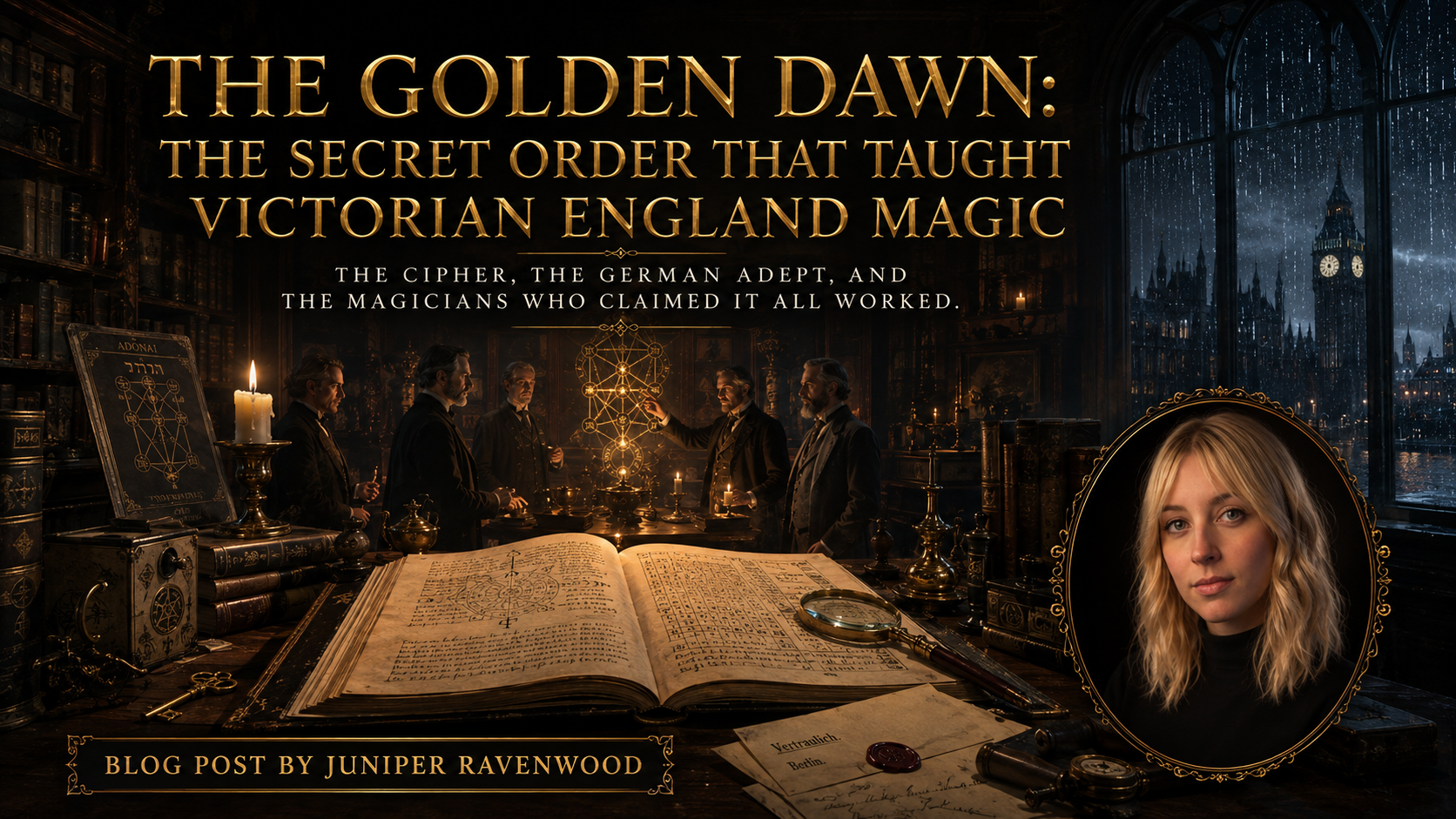
🌅 The Golden Dawn: When Victorian Magicians Claimed the Rituals Worked
By Juniper Ravenwood
A Cipher Waiting to Be Opened 🔐
There is something irresistible about a secret written in code. A normal manuscript offers information, but a cipher makes a promise: someone took deliberate steps to conceal what these pages contain—and perhaps there was a reason ordinary people were never supposed to read them.
During the closing years of the nineteenth century, London coroner William Wynn Westcott came into possession of approximately sixty folios written in cipher. When decoded, the pages revealed the framework for an elaborate system of occult initiation involving astrology, alchemy, tarot, geomancy and the Kabbalistic Tree of Life.
The material was incomplete, but it contained enough to serve as the skeleton of an entire magical order.
Westcott joined forces with physician William Robert Woodman and occult scholar Samuel Liddell MacGregor Mathers. Together, they transformed the cryptic outlines into the teachings and rituals of the Hermetic Order of the Golden Dawn.
The Woman in Germany ✉️
Westcott claimed that the decoded material led him to Fräulein Anna Sprengel, an advanced Rosicrucian initiate living in Germany. Letters were exchanged, and Sprengel supposedly granted Westcott and his associates permission to establish an English temple.
This correspondence gave the Golden Dawn something every secret order desires: an impressive lineage.
Its founders were not merely Victorian occult enthusiasts inventing ceremonies inside a London parlor. They were supposedly representatives of an older European tradition preserving ancient spiritual knowledge.
There was only one problem.
No independent evidence has conclusively established that Anna Sprengel existed. No confirmed German temple stepped forward. No reliable outside witness was known to have met her. Sprengel may have been an authentic initiate who successfully concealed her identity—or she may have been created to provide the Golden Dawn with authority it had not earned.
Yet the order that emerged from her letters was very real.
Inside the Magical Temple 🕯️
Founded in London in 1888, the Golden Dawn attracted an extraordinary membership. Poet W.B. Yeats, actress Florence Farr, writers Arthur Machen and Algernon Blackwood, artist Pamela Colman Smith, occult scholar A.E. Waite and the notoriously ambitious Aleister Crowley all became connected with its world.
Members entered temples filled with robes, lamps, banners, swords, wands and intricate symbolic designs. They memorized correspondences linking planets, colors, metals, perfumes, Hebrew letters and tarot cards. Initiates who reached the Inner Order studied practical invocation, scrying, talismanic magic and visionary exploration.
This was not magic presented as entertainment. The members approached it as a discipline.
Many claimed that the discipline produced results.
When Something Answered 👁️
W.B. Yeats described experiments in which symbols appeared to unlock uncontrollable mental imagery. Florence Farr became deeply involved with Egyptian symbolism, scrying and coordinated magical work. Other initiates recorded presences, visionary landscapes, astral journeys and encounters with apparent intelligences.
They understood imagination. These were poets, actors, artists and disciplined writers who spent their lives working with imagery and symbolism. Nevertheless, many believed their magical experiences involved something more than fantasy.
Above the order’s visible leadership supposedly stood the Secret Chiefs—advanced human adepts or nonphysical spiritual intelligences guiding the organization from beyond ordinary reach.
MacGregor Mathers claimed that he communicated with these hidden authorities. That claim supplied new teachings, but it also gave Mathers enormous power. When the person issuing instructions cannot be seen, questioned or independently contacted, the boundary between spiritual revelation and organizational control becomes dangerously thin.
The Temple Cracks ⚔️
The Golden Dawn eventually tore itself apart through disputes involving leadership, authority and the authenticity of its founding documents. Mathers accused Westcott of fabricating the Sprengel correspondence. Florence Farr and other senior members resisted Mathers’s control. Aleister Crowley’s attempt to seize the order’s London rooms produced the wonderfully theatrical confrontation known as the Battle of Blythe Road.
Then came the Horos scandal. Two confidence tricksters obtained Golden Dawn material and used occult claims as part of a fraudulent organization connected to serious criminal abuse. Secret rituals entered public court proceedings and newspaper coverage, exposing the order to ridicule and disgrace.
By the early twentieth century, the original Golden Dawn had fragmented.
Its magic, however, escaped the ruins.
Magic, Psychology or Something Between? 🧠
A skeptical explanation does not require us to treat every initiate as foolish or dishonest. Golden Dawn rituals combined candlelight, incense, elaborate costumes, memorized movement, emotionally charged divine names and prolonged concentration. Those conditions can encourage trance, guided imagery, heightened expectation and remarkably vivid internal experiences.
But if the purpose of the ritual was to transform consciousness, unleash creativity and make symbolic forces feel alive, a psychological explanation does not necessarily mean the magic failed.
Perhaps it worked exactly as intended.
The unanswered question concerns the source of what practitioners encountered. Were they meeting independent beings, exploring forgotten regions of the mind or entering a symbolic world strengthened by the expectations of everyone who had gone there before?
The Order That Refused to Disappear 🌅
The Golden Dawn’s influence can still be found in ceremonial magic, modern witchcraft, occult tarot, fantasy literature, horror fiction and nearly every popular image of a secret magical society. Its members carried the system into poetry, theater, painting and new occult organizations.
Anna Sprengel may never have existed. The Secret Chiefs may have been spiritual masters, psychological projections or convenient inventions. The original order may have collapsed beneath the weight of human vanity and ambition.
Yet something undeniably powerful emerged from those coded pages.
Perhaps the Golden Dawn’s greatest act of magic was not summoning a spirit or charging a talisman. Perhaps it was transforming a questionable manuscript into a living tradition that continues influencing how we imagine magic more than a century later.
And if an invented woman can authorize real temples, redirect real lives and haunt history without ever possessing a body, perhaps we should be careful about declaring her entirely unreal. 🕯️
Until next time, keep one light burning—and never assume that a silent manuscript has nothing to say.
—Juniper Ravenwood

Producer, The Shadow Frequency
Juniper Ravenwood is the heart and soul behind the production of The Shadow Frequency podcast, bringing her passion for the paranormal and storytelling to every episode. Born in the wide-open plains of South Dakota, Juniper grew up surrounded by tales of mystery and the unexplained, which sparked her fascination with the eerie unknown. With a deep love for podcasting and the boundless world of the internet, she crafts each episode with a blend of spooky atmosphere and meticulous care, ensuring listeners are drawn into the shadows. As the producer, Juniper not only manages the show’s chilling vibe but also connects with fans through the Mailbag segment and the podcast’s vibrant online community. When she’s not diving into creepy stories or exploring the digital realm, you can find her chasing new paranormal mysteries or dreaming up ways to make The Shadow Frequency even spookier. Connect with Juniper and the show at shadowfrequencypodcast.com or shadowpodcast@protonmail.com!
Lost Cities Beneath the Amazon Canopy


 RSS Feed