Slender Man: When Fiction Became Folklore
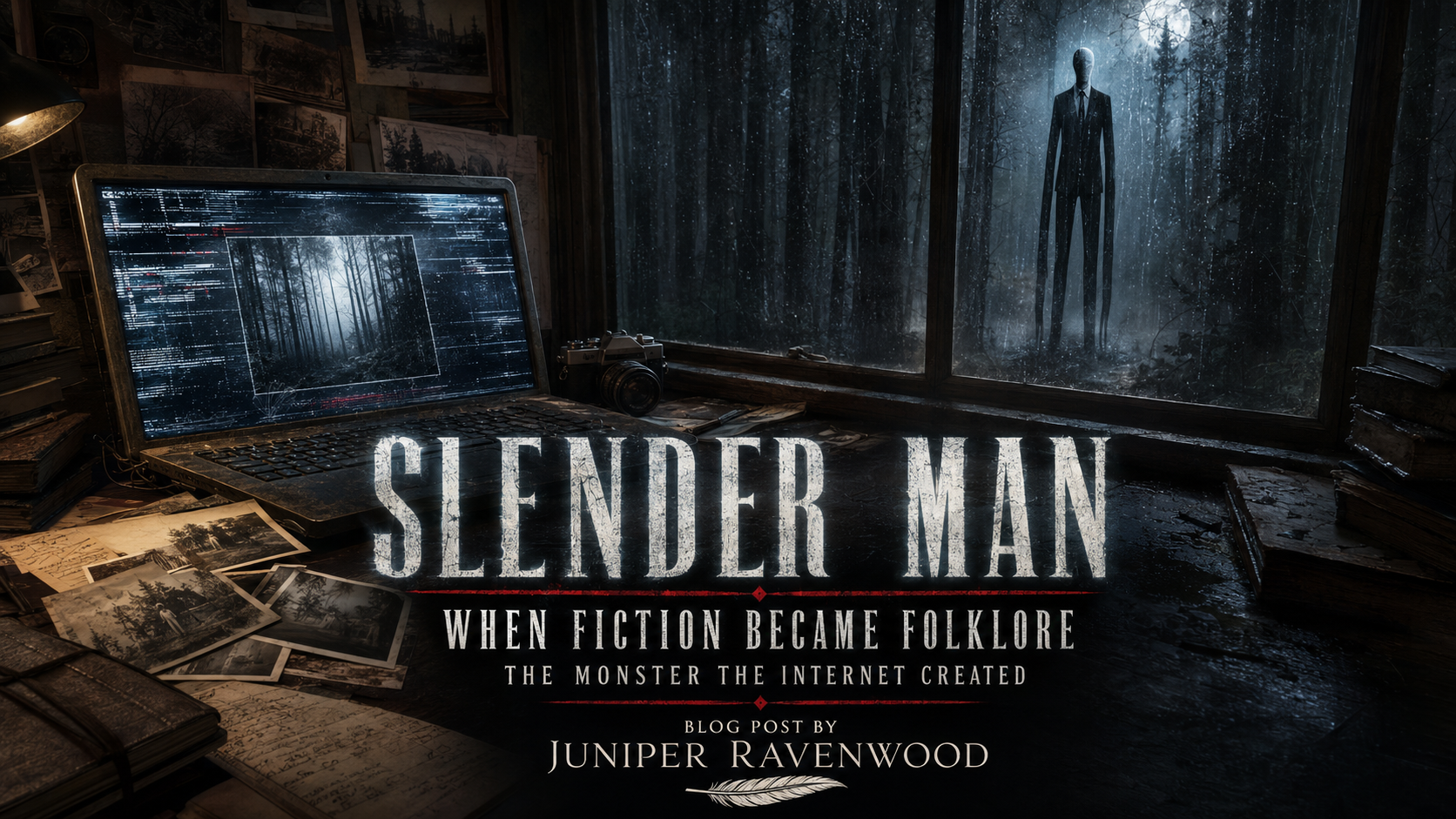
Slender Man: When Fiction Became Folklore 👤🌲
Author: Juniper Ravenwood
A Monster with a Birth Certificate 🗓️
Most legendary monsters emerge from a fog of uncertain history. Their origins are buried beneath centuries of campfire warnings, regional superstitions, and stories repeated so many times that no one can identify the first teller. Slender Man is different. We know when he arrived.
On June 10, 2009, a user named Victor Surge posted two altered black-and-white photographs in a Something Awful forum thread. Children appeared in the foreground. Behind them stood an impossibly tall, thin figure with an empty white face and limbs that did not seem entirely human. The captions mentioned missing children, a library fire, a vanished photographer, and something called “the Slender Man.”
The artist behind Victor Surge was Eric Knudsen. The images were fiction, created for an online paranormal-image contest. That should have made the mystery easy to contain. Instead, those two photographs became the open door through which one of the internet age’s most recognizable monsters entered the world.
The Power of an Empty Face 👤
Slender Man’s design is frightening because it offers so little information. He wears a black suit and tie, familiar clothing that becomes deeply unnatural when placed on an elongated body in a dark forest. His arms resemble branches. His height changes from image to image. Most importantly, his face has no eyes, mouth, age, expression, or identity.
Human beings instinctively search faces for emotion and intention. Slender Man denies us both. His blankness forces the observer to supply the motive. Is he watching the children? Calling to them? Protecting them? Hunting them? Nothing in his expression can contradict the fear we place upon him.
That absence also made him perfect for collaborative storytelling. He arrived without a fixed origin, an established set of powers, or a complete history. Thousands of creators could add their own fragments without breaking the central idea. A simple silhouette became a container for collective fear.
The Internet Manufactured a Past 🗂️
Once the first pictures began circulating, other storytellers created fabricated photographs, reports, journals, symbols, witness statements, and historical references. An invented Germanic figure called Der Großmann—“the Great Man”—was presented as though it had haunted European folklore for centuries.
Slender Man acquired followers known as proxies and an expanding collection of supposed abilities: appearing without moving, disrupting cameras, erasing memories, influencing minds, producing additional limbs, and causing a collection of symptoms called “Slender sickness.”
The fascinating part is not merely that people added to the fiction. It is that later audiences could encounter those additions without ever seeing the original 2009 post. A fictional “historical” reference was repeated on another website, placed in a video, and shared as background information. With each retelling, the documented beginning became less visible.
The monster began to feel as though the internet had rediscovered him rather than created him. 🕸️
From Marble Hornets to Eight Pages 📹🎮
Only ten days after the original images appeared, Marble Hornets began releasing videos on YouTube. Its story arrived as a collection of tapes and fragmented recordings rather than a conventional television program.
A tall figure called the Operator appeared in backgrounds while cameras glitched, memories failed, and viewers searched every frame for hidden evidence.
Then Slender: The Eight Pages placed players alone in a forest with a flashlight. The goal was simple: locate eight pages while avoiding the faceless figure. Every page increased the tension. Static announced that he was near, but seeing him made the danger worse. The game taught players to scan tree lines, examine shadows, and interpret every pale vertical shape as a possible threat.
That is how folklore grows. A central image remains recognizable while each storyteller changes the details. Slender Man accomplished online, in a matter of days and years, what older legends often required generations to achieve.
When a Story Causes Real Harm ⚠️
Any responsible discussion of Slender Man must address the 2014 attack in Waukesha, Wisconsin. After a sleepover, two twelve-year-old girls attacked their friend, Payton Leutner, stabbing her nineteen times and leaving her gravely wounded. Payton survived after crawling toward a roadway, where a bicyclist found her and summoned help.
The attackers’ beliefs about Slender Man became entangled with the crime, including ideas about becoming his proxies and protecting their families. This does not make the attack paranormal evidence, and Payton’s suffering should never be transformed into supernatural entertainment.
Serious mental illness was central to the case, and millions of people encountered Slender Man stories without becoming violent.
The tragedy demonstrates something real and sobering: fiction can influence behavior when it becomes part of an isolated and distorted belief system. A monster does not require a physical body to leave consequences in the world.
The Mind Behind the Tree Line 🧠🌲
There is no authenticated historical record establishing Slender Man before 2009. The original photographs were altered, Der Großmann was invented, and the creature’s powers developed through collaborative storytelling.
Psychology offers strong explanations for later “sightings.” Pareidolia encourages the brain to find a human form among branches and shadows. Expectation teaches us what to notice. Nightmares and sleep paralysis can place a presence beside the bed. Reconstructive memory can cause a newly learned image to reshape an older fear.
Folklorists have also discussed Slender Man through “reverse ostension.” Normally, an unusual event inspires a legend. In reverse ostension, the legend is invented first, and people then create or interpret experiences as evidence of it. The footprints appear after the creature has been drawn.
Some paranormal thinkers go further, comparing the phenomenon to a thought-form or tulpa supposedly strengthened through concentrated attention. There is no scientific evidence that belief created a physical being in a black suit. Yet millions of people pictured the same silhouette, dreamed about it, drew it, feared it, and searched the woods for it. That attention unquestionably created a powerful cultural presence.
Does a Monster Need a Body? 🕯️
We know who created Slender Man. We know when the first images appeared. We can trace the videos, games, fabricated histories, and evolving rules. Even so, knowledge does not entirely dissolve the feeling that comes when a flashlight catches a pale shape between dark trees.
Perhaps Slender Man’s most enduring power is not invisibility, teleportation, or mind control. Perhaps it is the ability to change the appearance of empty space. Once you have learned what might be waiting in the distance, an ordinary forest never looks quite as empty again.
So tell me, my shadowy friends: does a monster need a body to be real, or does it become real the moment it changes what you see, what you remember, and what you fear?
Stay curious, keep watching the tree line, and never assume the static is empty.
— Juniper Ravenwood 🪶
🔗 More episodes & merch: shadowfrequencypodcast.com

Producer, The Shadow Frequency
Juniper Ravenwood is the heart and soul behind the production of The Shadow Frequency podcast, bringing her passion for the paranormal and storytelling to every episode. Born in the wide-open plains of South Dakota, Juniper grew up surrounded by tales of mystery and the unexplained, which sparked her fascination with the eerie unknown. With a deep love for podcasting and the boundless world of the internet, she crafts each episode with a blend of spooky atmosphere and meticulous care, ensuring listeners are drawn into the shadows. As the producer, Juniper not only manages the show’s chilling vibe but also connects with fans through the Mailbag segment and the podcast’s vibrant online community. When she’s not diving into creepy stories or exploring the digital realm, you can find her chasing new paranormal mysteries or dreaming up ways to make The Shadow Frequency even spookier. Connect with Juniper and the show at shadowfrequencypodcast.com or shadowpodcast@protonmail.com!

Lost Cities Beneath the Amazon Canopy


 RSS Feed