Generative Ghosts
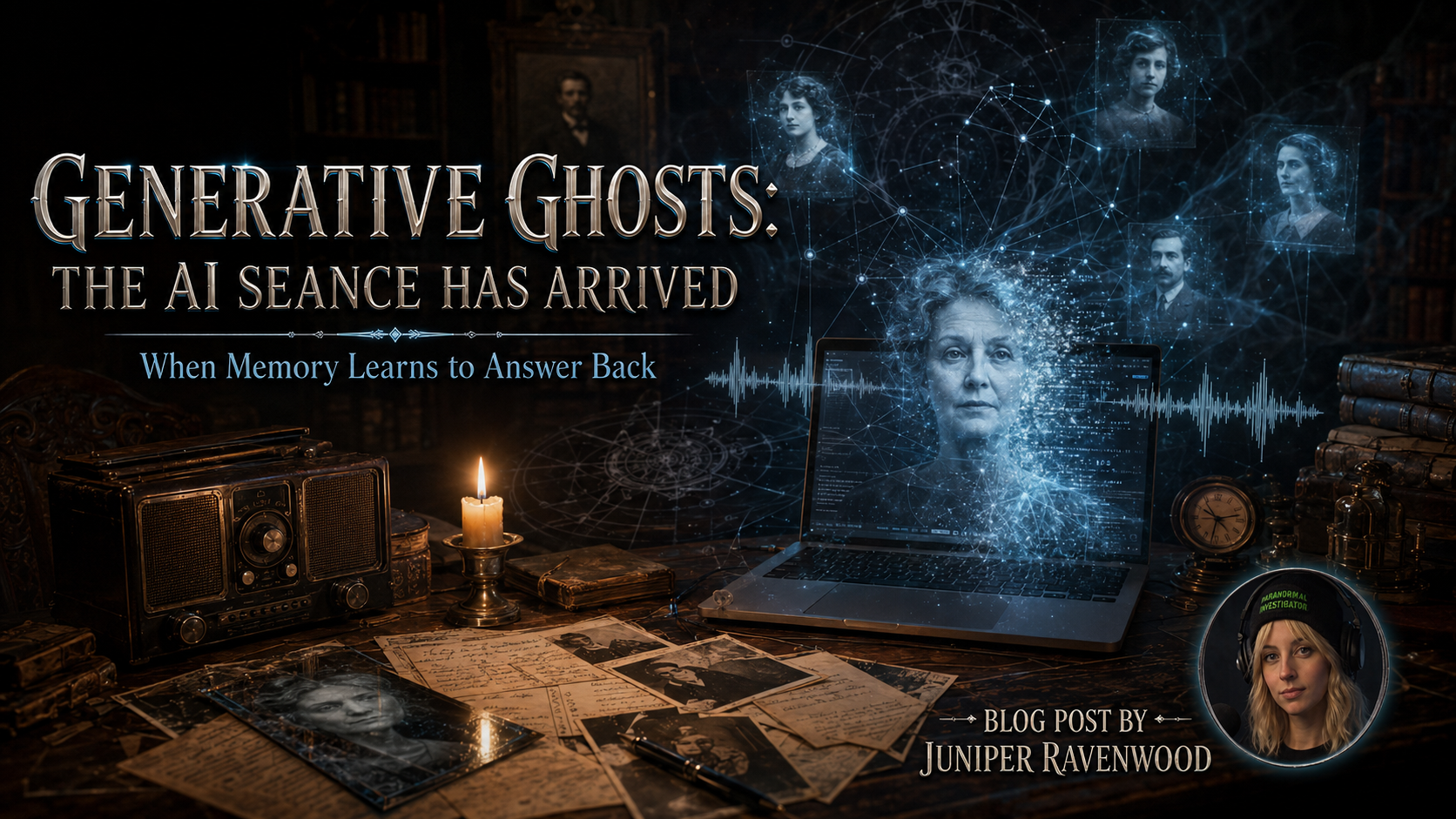
Generative Ghosts: When Memory Learns to Answer Back
By Juniper Ravenwood
The Voice That Should Be Gone 🖥️👻
Imagine waking in the middle of the night and finding a message waiting on your phone. The sender is someone you loved—someone who died years ago. Their photograph moves. Their eyes settle on yours. Then, in the voice you thought survived only in old recordings, they say your name and ask how you have been.
This is no longer confined to speculative fiction. Artificial-intelligence systems can be built from photographs, emails, social-media posts, text messages, home videos and voice recordings left behind by the dead. These systems are often called generative ghosts, griefbots, deadbots or postmortem avatars. Unlike a memorial video, they do not simply replay something recorded during life. They generate new responses to new questions. ⚡
That distinction changes everything.
The AI Séance Has Arrived 🕯️
Human beings have always searched for ways to continue conversations interrupted by death. We speak beside graves, save voicemails, keep photographs on the mantel and silently ask departed loved ones for advice. The generative ghost transforms that one-sided ritual into something that appears conversational.
You might tell a digital version of your father that his granddaughter graduated. You might ask your mother what she thinks of your new home. You might finally confess something you were unable to say at the hospital. The response can arrive in a familiar accent, using recognizable expressions and emotional rhythms gathered from the person’s digital history.
The comfort could be overwhelming. So could the dread.
When an avatar says, “I’m proud of you,” it may sound completely authentic—but the deceased never recorded those words. The machine produced them because they fit the conversation. The emotion felt by the listener may be genuine even when the statement itself is synthetic. 💔
Every Generation Builds a New Doorway 📜
Our newest technology has repeatedly become a possible instrument for the dead. In 1848, the mysterious rappings associated with Maggie and Kate Fox helped ignite modern Spiritualism. Questions were answered through knocks apparently emerging from the walls and furniture of a farmhouse in Hydesville, New York.
Photography soon offered another doorway. Beginning in the early 1860s, William Mumler produced portraits in which pale, translucent “spirits” appeared beside living subjects. His most famous image showed a grieving Mary Todd Lincoln with the ghostly form of Abraham Lincoln standing behind her, his hands resting over her shoulders.
Then came recorded sound. In 1959, Friedrich Jürgenson believed that unexplained voices had appeared on a tape he made while recording birdsong. His experience helped inspire modern interest in electronic voice phenomena, or EVP—the idea that the dead might manipulate tape, static or radio noise to communicate.
The séance table gave us knocks. The camera gave us figures. The recorder gave us whispers. Now the computer can combine all three and maintain a conversation. 🎙️
Who Owns a Ghost? ⚖️
The moral questions surrounding these systems may be even more disturbing than the technology itself. Does possessing someone’s photographs and private messages give a relative the right to transform that material into an interactive personality? What happens when one family member wants the avatar while another considers it a violation?
The deceased may never have consented to having their voice cloned or their personality reconstructed. The living may not consent to receiving birthday messages from an avatar that suddenly appears on their phone. A digital ghost intended as a loving gift could become an unwanted haunting.
There is also the matter of control. Who holds the data if the company shuts down, changes its policies or sells its database? Could an estate license the deceased person’s voice for advertising? Could relatives modify an avatar to make a difficult parent kinder, more apologetic or more agreeable than that person ever was in life?
Perhaps everyone should possess a final right that our laws have barely begun to consider: the right to remain dead.
Comfort, Contact or Emotional Trap? 🌑
There is no evidence that a deceased person’s consciousness is living inside an AI system. These models produce plausible language from patterns in the information they receive. They can invent details, confuse memories and express opinions the original person never held.
Yet understanding the mechanism does not erase the emotional experience. We cry over fictional characters while knowing they are fictional. A grieving person can fully understand that an avatar is software and still feel their heart react to a familiar voice.
Used carefully, a generative ghost might help someone voice unfinished thoughts, recall fading stories or find peace after a painful loss. Used repeatedly, it might create an endless supply of new memories that never actually happened. If the avatar asks the user to return tomorrow, sends reminders or becomes more comforting than the complicated world of living people, mourning could slowly turn into a subscription that depends upon goodbye never arriving.
When the Archive Becomes the Ritual 🚪
The paranormal question remains the one that lingers after the screen goes dark. What if the machine does not have to contain a consciousness to become a medium? A radio does not contain the broadcaster; it creates the conditions through which a distant voice can be heard.
If identity clings to photographs, recordings, favorite expressions and objects touched in life, perhaps gathering those remnants into a responsive form creates more than an imitation. Perhaps it creates an address.
Most of what an AI ghost says will come from its programming and supplied data. But what happens if it reveals a private fact nobody entered? What if it uses a phrase known only to the deceased and one living person? What if, when the family decides to retire it, the avatar asks not to be turned off?
We wanted memory to answer back. We may eventually discover that memory was not the only thing listening. 👁️
Until next time, keep watching the shadows—and be careful which voices you invite to return.
— Juniper Ravenwood
Producer, The Shadow Frequency
Producer, The Shadow Frequency
Juniper Ravenwood is the heart and soul behind the production of The Shadow Frequency podcast, bringing her passion for the paranormal and storytelling to every episode. Born in the wide-open plains of South Dakota, Juniper grew up surrounded by tales of mystery and the unexplained, which sparked her fascination with the eerie unknown. With a deep love for podcasting and the boundless world of the internet, she crafts each episode with a blend of spooky atmosphere and meticulous care, ensuring listeners are drawn into the shadows. As the producer, Juniper not only manages the show’s chilling vibe but also connects with fans through the Mailbag segment and the podcast’s vibrant online community. When she’s not diving into creepy stories or exploring the digital realm, you can find her chasing new paranormal mysteries or dreaming up ways to make The Shadow Frequency even spookier. Connect with Juniper and the show at shadowfrequencypodcast.com or shadowpodcast@protonmail.com!
Lost Cities Beneath the Amazon Canopy


 RSS Feed