The Person Making Supper Beneath Los Angeles
📰 The Person Making Supper Beneath Los Angeles
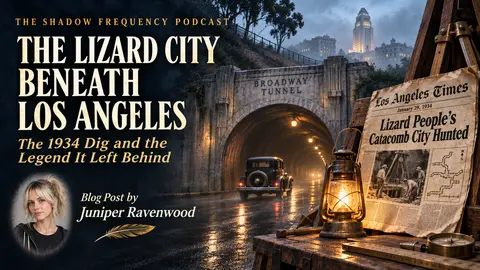
By Juniper Ravenwood, producer of The Shadow Frequency
Companion blog for Episode 374 · November 22, 2026
🪨 The smallest figure on the page
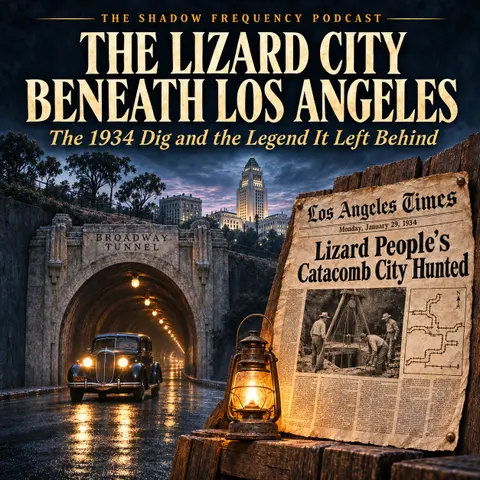
My shadowy friends, I spent a good part of this episode looking at somebody making supper. At least, that’s how I read the little figure in the old newspaper drawing. Somebody is bent over a mortar, working a pestle. I couldn’t tell you what’s in the bowl. What I can tell you is that the artist had been given an entire lost civilization to draw, complete with a fortune in gold, and still found room for a person with an ordinary job to finish.
A few inches away is a photograph of George Warren Shufelt’s crew getting water out of a shaft. Those men had a job to finish, too. The newspaper put them within a handspan of people they hoped had lived under Los Angeles thousands of years earlier. When Matt opened that page on the show, I realized how easily my eye had crossed a distance those men never managed to travel.
🪣 What a bucket of water cost
The bargain on Fort Moore Hill was good enough to bring volunteers to work during the Depression. The county would get half of any treasure. The men doing the digging stood to get a share. Twenty-eight feet to a cache of Spanish gold sounds like a distance you could explain to somebody waiting for you to bring home a paycheck. I wonder how that conversation went after the target moved to a different shaft, and again after an earthquake sent the diggers back to the surface.
By the time Jean Bosquet wrote about them in January 1934, Shufelt was prepared to go a thousand feet. I keep thinking about the difference between deciding to dig another foot and being the person who has to do it. Water pouring back into yesterday’s work could eat up a morning. Meanwhile, anybody with a newspaper could skip straight to the treasure room.
🌊 How would a child know the tide was in?
The detail I’d most like to ask Little Chief Greenleaf about is the breeze. In the story attributed to him, people had survived a terrible fire and built places where their families could shelter if the sky burned again. Far below the living chambers, the ocean moved in and out of passages. That movement was supposed to push fresh air up to the people inside.
Imagine trying to settle a child in one of those rooms on the first night. The child asks how you know the tunnel goes all the way to the sea. You hold up a damp finger and let them feel the draft for themselves. That’s a scene I supplied, of course. I mention it because by the time I’d finished picturing it, I was already worrying about whether those two could get home. A good storyteller can do that with one practical detail.
🗓️ The date I’d circle in pencil
Edith Elden Robinson described a vision of two buried civilizations on December 22, 1933. She later held the famous January newspaper for a photograph. You can understand why a psychical-research editor found the sequence extraordinary. Then there’s November 21. Eugene Coughlin had already put Greenleaf’s buried city into print that day, a month before the experience Robinson described. We have a date for the story’s public appearance. We have no record of which paper Edith picked up that morning.
I’m glad both dates survived. I can take Edith seriously enough to listen to what she said and still wonder why it was the January story, rather than the November one, that an editor knew about. A missing month is a surprisingly roomy place for a mystery to live.
🦎 Who first gave them scales?
When I say “Lizard People,” what do you see? Greenleaf’s people took the lizard as an emblem of long life. The families in that early account had human hands, which brings me back to the pestle. By the 1980s, versions of the story invited readers to imagine reptilian people still living under the city. The next time you come across the map, look for Broadway and Second. Then take a look at who’s doing the cooking. I’d love to know which one you saw first.
Until the next strange case, my shadowy friends,
Juniper Ravenwood 🌙

Producer, The Shadow Frequency
Juniper Ravenwood is the heart and soul behind the production of The Shadow Frequency podcast, bringing her passion for the paranormal and storytelling to every episode. Born in the wide-open plains of South Dakota, Juniper grew up surrounded by tales of mystery and the unexplained, which sparked her fascination with the eerie unknown. With a deep love for podcasting and the boundless world of the internet, she crafts each episode with a blend of spooky atmosphere and meticulous care, ensuring listeners are drawn into the shadows. As the producer, Juniper not only manages the show’s chilling vibe but also connects with fans through the Mailbag segment and the podcast’s vibrant online community. When she’s not diving into creepy stories or exploring the digital realm, you can find her chasing new paranormal mysteries or dreaming up ways to make The Shadow Frequency even spookier. Connect with Juniper and the show at shadowfrequencypodcast.com or shadowpodcast@protonmail.com!
What Went Up the Tree? The Juárez Valley Creature and a Bigfoot Called Dack


 RSS Feed