Dolphins: The Alien Intelligence Already Here
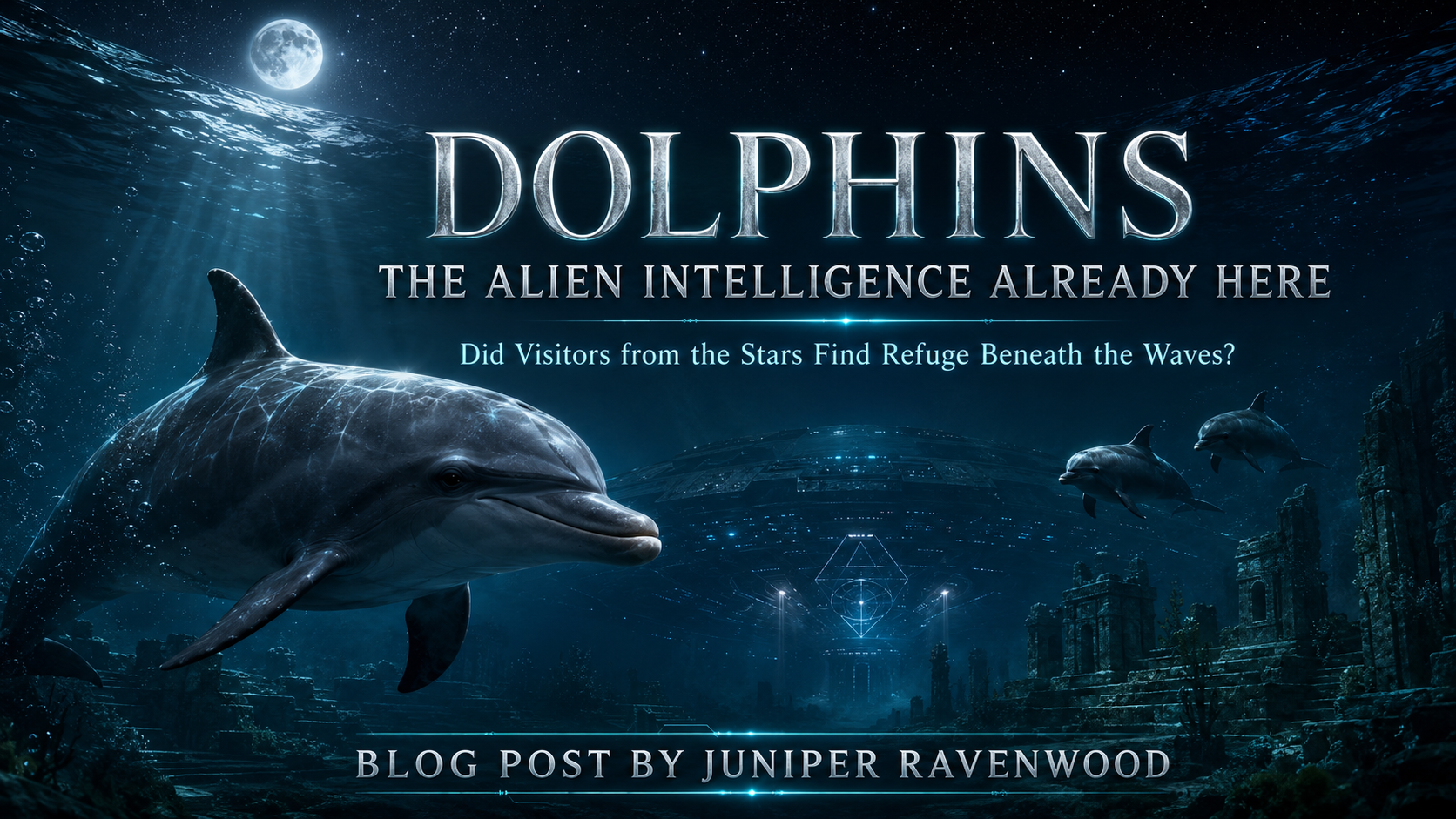
Dolphins: The Alien Intelligence Already Here 🐬👽
Did Visitors From the Stars Find Refuge Beneath the Waves?
Author: Juniper Ravenwood
The Other Minds Beneath the Surface 🌊
My shadowy friends, imagine standing at the edge of the ocean after sunset. Beyond the final strip of reflected moonlight lies a world ruled by pressure, darkness and sound. Human beings can visit that world only with equipment, yet dolphins cross it with effortless confidence. They communicate, cooperate, hunt, play, teach and navigate through places our eyes cannot penetrate.
We call them animals because that is where our system of classification places them—but what if their minds have been shaped by such a different reality that they are, in the most meaningful sense, an alien intelligence already here?
That question lies at the heart of Episode 365 of The Shadow Frequency: “Dolphins: The Alien Intelligence Already Here—Did Visitors From the Stars Find Refuge Beneath the Waves?”
The literal theory appears in several forms. Some believers claim dolphins were brought to Earth from a distant ocean planet. Others suggest extraterrestrials altered an ancient marine mammal, accelerating its intelligence and leaving behind a biological observer. Still other accounts connect dolphins and whales to Sirius, describing them as telepathic guardians or intermediaries waiting for humanity to become ready for contact.
There is no physical evidence proving any of those claims. Yet the documented reality of dolphin intelligence is strange enough to explain why the theory refuses to disappear.
A World Built From Echoes 🔊
A dolphin experiences its surroundings in a way no human can fully reproduce. By sending out rapid clicks and interpreting the returning echoes, it can determine the location, movement and physical qualities of objects hidden in dark or murky water.
We describe this as echolocation, but the tidy scientific word barely captures the experience. A dolphin does not merely hear a click return. Its brain transforms sound into a living map.
Then there is the way dolphins rest. Instead of allowing the entire brain to sleep at once, dolphins can rest one hemisphere while the other remains alert enough to breathe, surface and monitor the water. In one remarkable vigilance study, dolphins continued responding accurately to echolocation targets over a fifteen-day period with little loss of performance.
A mind that never completely switches off sounds less like a sleeping animal and more like a watchman maintaining an unbroken vigil beneath the waves. 👁️🌊
Names, Alliances and Culture 🐬
Bottlenose dolphins develop distinctive signature whistles that function somewhat like individual acoustic names. Other dolphins can copy those whistles when addressing particular members of their social group. Mothers alter their calls around calves in a manner researchers have compared with baby talk.
These animals do not move through the ocean as an anonymous school. They recognize individuals and maintain lasting social identities.
In Shark Bay, Australia, male dolphins build alliances within larger alliances and coalitions. Their survival depends on memory, cooperation, rivalry and relationship management. Other Shark Bay dolphins tear marine sponges from the seafloor and wear them over their snouts while searching for hidden prey. The technique is learned and passed from experienced animals to younger dolphins, creating a local tool-using tradition.
This is culture without cities, books or metal. A dolphin has no hands with which to raise monuments, and the ocean offers no fire with which to begin an industrial age.
If an intelligent society developed completely underwater, perhaps its history would be carried through memory, sound and living teachers rather than buildings and written records. We might search for ruins and machines while failing to recognize the civilization swimming beside us.
When Dolphins Entered the Search for Aliens 📡
The connection between dolphins and extraterrestrial intelligence is not limited to modern internet folklore.
In 1961, John C. Lilly joined Frank Drake, Carl Sagan, Philip Morrison and other scientists at Green Bank, West Virginia, for an early scientific meeting devoted to communication with extraterrestrial life. The attendees informally called themselves the Order of the Dolphin, acknowledging Lilly’s belief that learning to communicate with dolphins could prepare humanity to communicate with beings from another world.
Lilly’s research soon traveled into controversial territory. At the Dolphin House on St. Thomas, Margaret Howe Lovatt lived and worked in a partially flooded environment with a bottlenose dolphin named Peter, attempting to teach him human speech. Lilly’s later experiments involving LSD damaged the project’s credibility, and Peter’s death cast a tragic shadow over the entire story.
The deepest failure may have been conceptual. Humans tried to make a dolphin reproduce human words instead of beginning with the language the dolphin already possessed. We entered another mind’s world, demanded that it sound like us and treated our inability to understand as its inability to speak.
Sirius, USOs and the Legend Beneath the Waves ✨
Modern alien-dolphin beliefs often point toward Sirius, spiritual contact accounts and reports of unidentified submerged objects. Witnesses sometimes describe strange craft or lights entering the ocean without an obvious impact, or rising from the water and disappearing into the sky.
No verified evidence connects such reports to dolphins, but the idea creates a powerful piece of contemporary folklore: perhaps the objects entering the sea are not hiding there. Perhaps they are returning home.
In that version of the mystery, dolphins become witnesses, partners or biological envoys for something dwelling below. Their friendliness toward humans becomes observation. Their appearances near vessels become surveillance. Their whistles become signals intended for a receiver we cannot detect.
It is a chilling interpretation—but interpretation is not proof.
The Scientific Reality—and the Mystery That Remains 🧬
The evolutionary record places dolphins firmly within Earth’s family tree. Fossils document the long transition of cetacean ancestors from four-legged land mammals to fully aquatic animals, and genetic evidence supports that history. Sirius B is a white dwarf, not a known ocean world, and there is no verified evidence that extraterrestrials engineered or transported dolphins.
Science can explain where the dolphin body came from, however, without fully revealing what it feels like to inhabit a dolphin mind. That mystery remains genuine.
Dolphins possess intelligence shaped by a sensory environment profoundly different from ours. Even if they are entirely terrestrial, meeting them may be the closest experience currently available to encountering an alien form of consciousness.
Artificial Intelligence Listens to the Ocean 🤖🌊
Today, researchers are trying a different approach. The CHAT system uses underwater computers, hydrophones and artificial whistles to explore limited two-way exchanges with wild dolphins.
DolphinGemma, developed through work involving Google, Georgia Tech and the Wild Dolphin Project, uses AI to analyze patterns in decades of dolphin recordings. It is not a completed dolphin translator, but it may help researchers detect structures human listeners have missed.
There is something beautifully eerie about this possibility. John Lilly believed communication with dolphins might prepare us for communication with aliens. Now we are asking one form of nonhuman intelligence—artificial intelligence—to help us understand another.
Somewhere beneath the black water, dolphins continue calling to one another as they have for ages. The signal is real. Only its meaning remains beyond us.
Perhaps dolphins did not come from the stars. Perhaps they do not need to. They already prove that an advanced social mind can share our planet while living inside a world we barely understand.
And if the ocean ever answers us clearly, we may discover that first contact began long before humanity thought to say hello. 🐬👽📡
Until next time, keep your ears tuned to the static—and never assume the darkest water is empty.
—Juniper Ravenwood
Producer, The Shadow Frequency

Producer, The Shadow Frequency
Juniper Ravenwood is the heart and soul behind the production of The Shadow Frequency podcast, bringing her passion for the paranormal and storytelling to every episode. Born in the wide-open plains of South Dakota, Juniper grew up surrounded by tales of mystery and the unexplained, which sparked her fascination with the eerie unknown. With a deep love for podcasting and the boundless world of the internet, she crafts each episode with a blend of spooky atmosphere and meticulous care, ensuring listeners are drawn into the shadows. As the producer, Juniper not only manages the show’s chilling vibe but also connects with fans through the Mailbag segment and the podcast’s vibrant online community. When she’s not diving into creepy stories or exploring the digital realm, you can find her chasing new paranormal mysteries or dreaming up ways to make The Shadow Frequency even spookier. Connect with Juniper and the show at shadowfrequencypodcast.com or shadowpodcast@protonmail.com!

Lost Cities Beneath the Amazon Canopy



 RSS Feed