The Green Jar and the Runestone
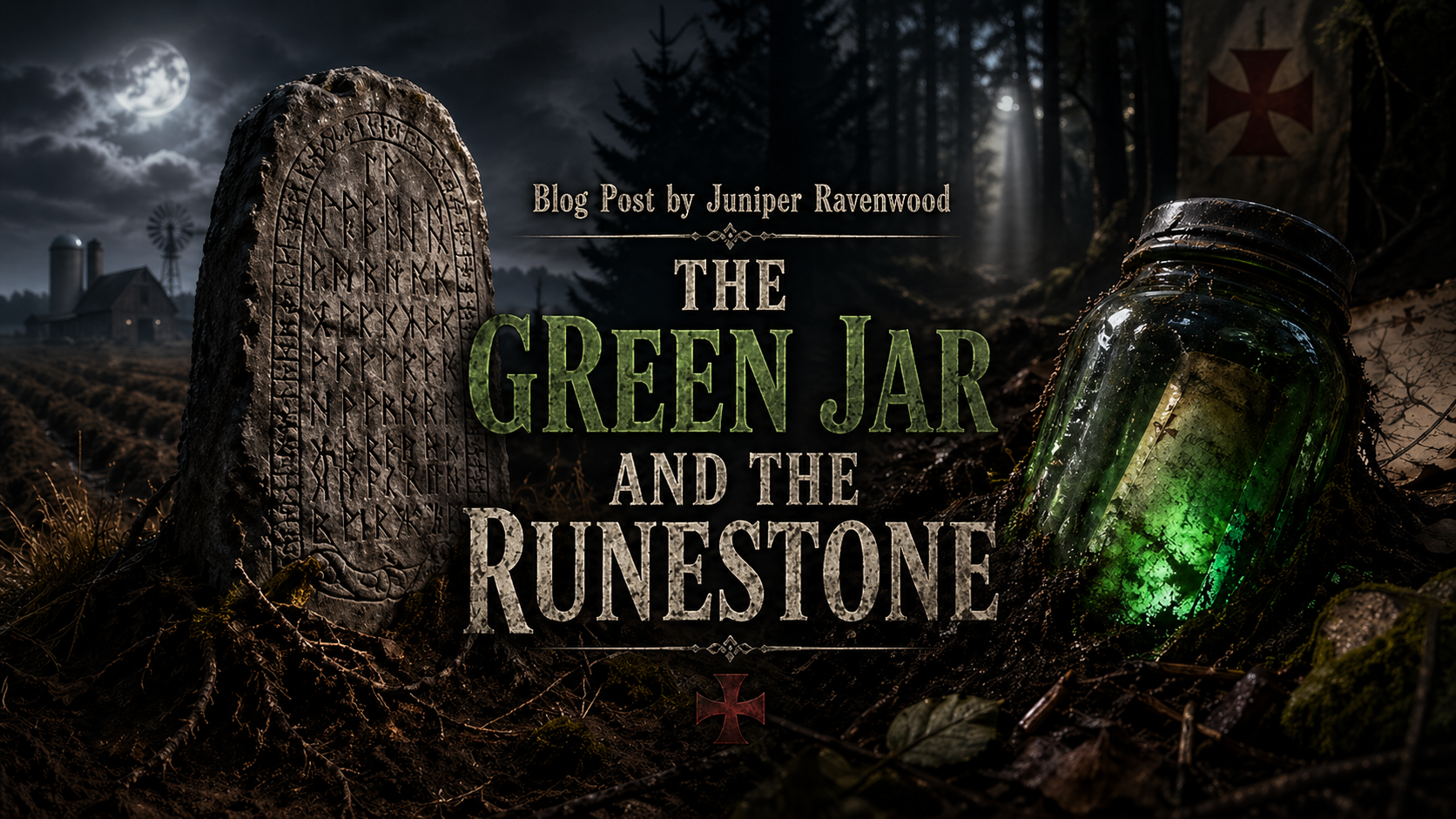
The Green Jar and the Runestone: A Trail of Stone, Secrets, and Forbidden History
Author: Juniper Ravenwood
A Stone in a Minnesota Field 🪨
Some mysteries do not begin with thunder, screams, or lights in the sky. Sometimes they begin with a farmer working the land, a tree root pulled loose, and a stone that should not have been there.
That is where Episode 334 of The Shadow Frequency begins — in western Minnesota in 1898, when Olof Öhman reportedly discovered what would become known as the Kensington Runestone. The object itself is simple enough to describe: a slab of stone carved with runic markings. But the story those markings appear to tell is anything but simple. The inscription suggests a Scandinavian expedition deep into North America in 1362, long before the version of history most of us were taught in school.
And that is where the unease begins. Because if the stone is genuine, it does not merely add a footnote to history. It opens a door.
The Scott Wolter Trail 🔍
Forensic geologist Scott Wolter has spent decades following the Kensington Runestone and related artifact claims into deeper and stranger territory. His approach has often centered on physical evidence — stone, weathering, carvings, symbols, and materials — which gives the story a different weight than a simple campfire legend.
In Wolter’s version of the trail, the Runestone is not an isolated curiosity. It is a marker. A clue. Possibly the first visible piece of a much larger hidden system involving medieval explorers, Knights Templar survivals, secret symbols, and knowledge preserved across generations.
That is what makes this case so fascinating for The Shadow Frequency. It does not ask us to look at one object and stop there. It asks whether one strange object might be part of a map.
The Knights Templar Shadow ⚔️
Once the Knights Templar enter the story, the atmosphere changes. Their official history is dramatic enough: power, wealth, secrecy, persecution, and downfall. But their afterlife in legend is even larger. For centuries, the Templars have been tied to rumors of hidden treasure, sacred knowledge, lost documents, and secret missions that survived their destruction.
The idea explored in this episode is that some current of Templar knowledge may have crossed the Atlantic and left behind signs — in stone inscriptions, encoded markings, family lines, and buried artifacts. It is a massive claim, and a controversial one, but it is also exactly the kind of mystery that refuses to stay quiet.
Jerusalem, Talpiot, and the Sacred Pressure Point 🕯️
The trail then moves to Jerusalem and the Talpiot Tomb, a real archaeological site discovered in 1980. The tomb became famous because of claims linking it to Jesus and his family — claims that many scholars and archaeologists have strongly disputed.
That controversy matters. Once Talpiot enters the story, the mystery is no longer only about who may have reached North America before Columbus. It becomes tangled with theology, sacred history, and the possibility of documents or traditions that certain groups may have believed were too dangerous to reveal.
This is where the episode steps onto truly unstable ground — not because every claim is proven, but because the implications are enormous.
The Green Jar in the Adirondacks 🏺🌲
And then comes the green jar.
According to Wolter’s recent claims, a sealed jar recovered from the Adirondack wilderness in August 2025 contained material tying together the Knights Templar, the Founding Fathers, the Talpiot Tomb, and a scroll that could carry extraordinary historical meaning.
The image is almost too perfect: a plain jar buried in the wilderness, waiting in silence, holding a document that may point back through centuries of hidden movement. Not a golden treasure chest. Not a cathedral vault. Just glass, dirt, paper, and the possibility that history left something behind for someone to find.
What Makes This Case Endure 👁️
The Green Jar and the Runestone endures as a mystery because it blends real artifacts with enormous questions. The Kensington Runestone exists. The Talpiot Tomb exists. Scott Wolter is a real public figure with a long history of controversial artifact research. But the connections between these pieces remain debated, disputed, and deeply speculative.
And maybe that is why the story works so well. It lives in the space between proof and possibility. Between archaeology and folklore. Between the official record and the strange feeling that something may have been left out.
Whether the green jar changes history or simply becomes another strange chapter in forbidden-history lore, it gives us one unforgettable question:
What if the past has been leaving markers for us all along?
— Juniper Ravenwood
The Shadow Frequency Podcast 🖤

Producer, The Shadow Frequency
Juniper Ravenwood is the heart and soul behind the production of The Shadow Frequency podcast, bringing her passion for the paranormal and storytelling to every episode. Born in the wide-open plains of South Dakota, Juniper grew up surrounded by tales of mystery and the unexplained, which sparked her fascination with the eerie unknown. With a deep love for podcasting and the boundless world of the internet, she crafts each episode with a blend of spooky atmosphere and meticulous care, ensuring listeners are drawn into the shadows. As the producer, Juniper not only manages the show’s chilling vibe but also connects with fans through the Mailbag segment and the podcast’s vibrant online community. When she’s not diving into creepy stories or exploring the digital realm, you can find her chasing new paranormal mysteries or dreaming up ways to make The Shadow Frequency even spookier. Connect with Juniper and the show at shadowfrequencypodcast.com or shadowpodcast@protonmail.com!
Lost Cities Beneath the Amazon Canopy


 RSS Feed