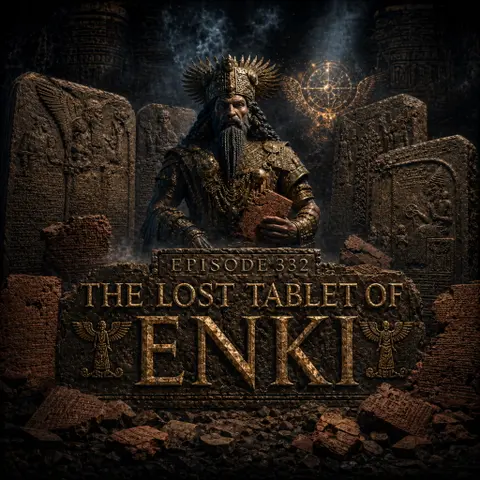
The Lost Tablet of Enki
📝 Blog Post
The Lost Tablet of Enki: Ancient Myth, Forbidden Knowledge, and the Mystery of Human Origins
Author: Juniper Ravenwood
The God Beneath the Waters 🌊
Some mysteries do not begin in haunted houses or dark forests. Some begin in the oldest cities of the world, pressed into clay by hands that vanished thousands of years ago.
Episode 332 of The Shadow Frequency takes us deep into ancient Mesopotamia, where temple cities rose from the dust, scribes carved history into tablets, and stories of gods, floods, kings, and creation were preserved in baked earth. At the center of tonight’s mystery stands Enki, later known as Ea — a god associated with wisdom, fresh water, magic, craft, creation, and hidden knowledge.
But Enki is not simply another figure from ancient mythology. He feels different. He advises. He intervenes. He protects mankind when other powers seem ready to destroy it. He stands at the edge of creation and the edge of catastrophe, always close to the secret machinery of the world.
The Tablet That Shouldn’t Exist 🏺
The idea of the “Lost Tablet of Enki” lives in that strange space between ancient record and modern interpretation. There is no accepted museum artifact officially recognized as a literal alien memoir from Enki. But that has not stopped the mystery from growing.
Ancient Mesopotamian myths already contain eerie ingredients: humanity shaped from clay, mixed with divine blood or substance, created to serve the gods. In flood traditions, Enki secretly warns a chosen human before disaster wipes the world clean. These stories are older than many later biblical traditions and carry a strange physicality that makes them feel less like distant metaphor and more like something remembered.
That is where the ancient-astronaut theory enters the room.
Enki, the Anunnaki, and the Ancient Astronaut Question 🛸
Zecharia Sitchin’s The Lost Book of Enki helped popularize the idea that the Anunnaki were not merely gods, but extraterrestrial visitors from Nibiru. In this version of the story, they came to Earth searching for gold, built settlements, created human workers, fought among themselves, and survived a catastrophic flood.
For believers in the Anunnaki theory, Enki becomes something more than a god of wisdom. He becomes a scientist, a genetic engineer, a commander, and possibly the one being who chose to preserve humanity when other powers wanted us gone.
Is that history? Myth? Reconstruction? Speculation? Maybe the most unsettling part is that the oldest stories leave enough shadows for the question to survive.
Floodwater, Clay, and Hidden Memory ⚡
What makes this topic so powerful is the pattern. Creation from clay. Divine substance. Higher beings needing labor. A flood that resets the world. A god who breaks ranks to save humanity. These are not soft bedtime stories. They are stories of power, survival, manipulation, and hidden knowledge.
Maybe the Lost Tablet of Enki was never one physical object buried in the desert. Maybe it is a symbolic name for something larger — a missing source, a broken record, or a memory scattered through multiple ancient traditions.
And maybe that is why Enki keeps rising from the deep water.
Why the Mystery Endures 👁️
The Lost Tablet of Enki endures because it touches one of the biggest questions humanity can ask: where did we come from?
Were the gods only myths? Were they metaphors for natural forces? Or did ancient people preserve distorted memories of real beings who shaped civilization and altered the human story?
The answer remains unresolved. But somewhere between clay tablets, flood legends, and the strange figure of Enki, the past still feels unfinished.
And if the old stories are whispering the truth, then perhaps mythology was never fiction.
Perhaps it was testimony.
Until next time, keep the old pages whispering.
— Juniper Ravenwood
The Shadow Frequency Podcast

Producer, The Shadow Frequency
Juniper Ravenwood is the heart and soul behind the production of The Shadow Frequency podcast, bringing her passion for the paranormal and storytelling to every episode. Born in the wide-open plains of South Dakota, Juniper grew up surrounded by tales of mystery and the unexplained, which sparked her fascination with the eerie unknown. With a deep love for podcasting and the boundless world of the internet, she crafts each episode with a blend of spooky atmosphere and meticulous care, ensuring listeners are drawn into the shadows. As the producer, Juniper not only manages the show’s chilling vibe but also connects with fans through the Mailbag segment and the podcast’s vibrant online community. When she’s not diving into creepy stories or exploring the digital realm, you can find her chasing new paranormal mysteries or dreaming up ways to make The Shadow Frequency even spookier. Connect with Juniper and the show at shadowfrequencypodcast.com or shadowpodcast@protonmail.com!

Lost Cities Beneath the Amazon Canopy



 RSS Feed