How to Spot an NPC
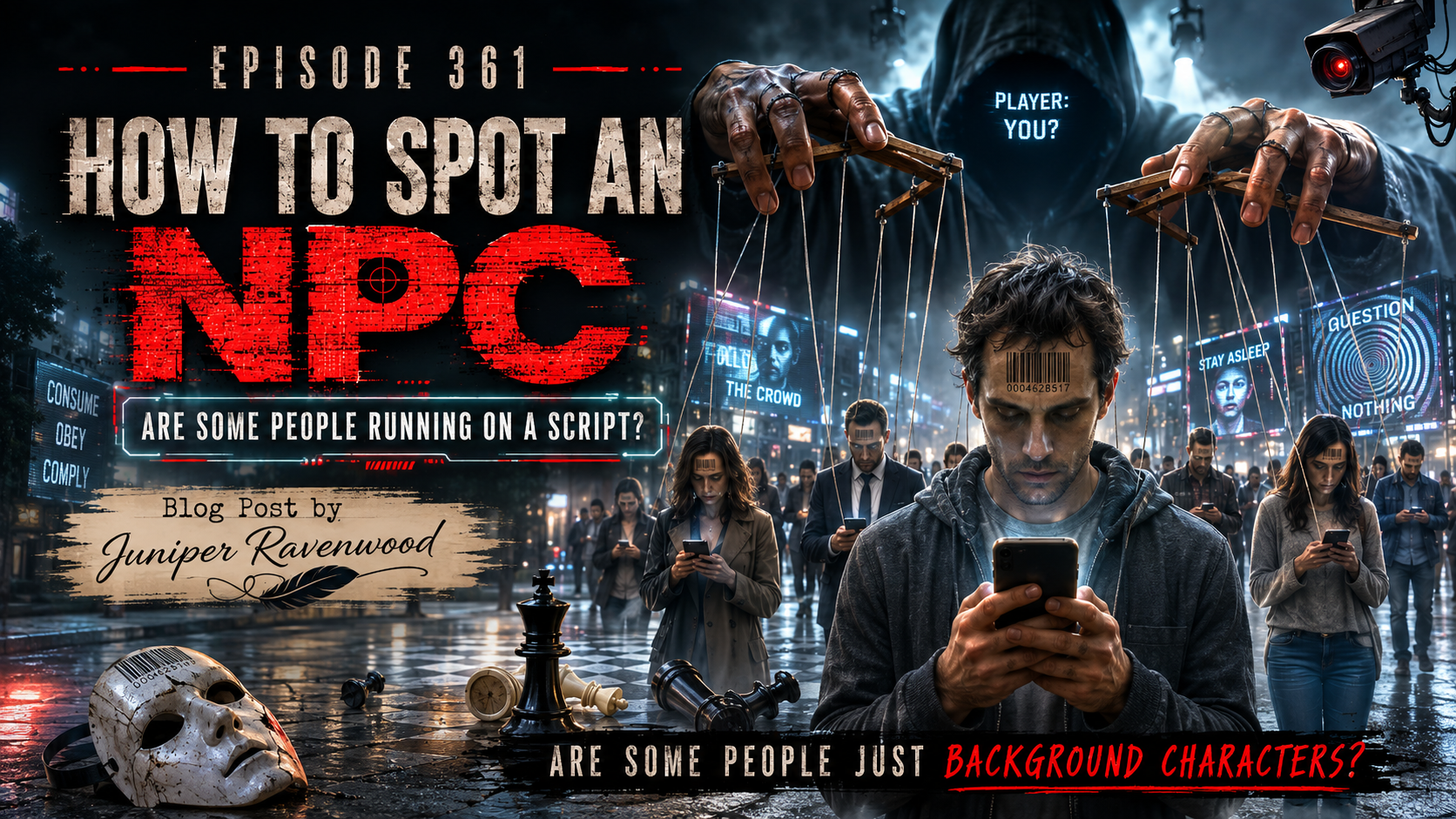
HOW TO SPOT AN NPC: ARE SOME PEOPLE RUNNING ON A SCRIPT? 👁️🎮
Author: Juniper Ravenwood
When Ordinary People Begin to Look Programmed 🔁
Have you ever watched someone move through a familiar routine and experienced a brief, uncomfortable feeling that you were witnessing a prerecorded sequence?
Perhaps it was the person who arrives at the same café every morning, orders the same drink, sits in the same chair, and repeats the same complaint to the same employee.
Perhaps it was a coworker who answered an unusual question with a sentence that did not quite fit—then repeated the sentence as though no other response was available.
Most of us would dismiss these moments as habit, distraction, exhaustion, or coincidence. But sometimes the behavior feels so rigid that the world briefly resembles a video game.
The streets become pathways.
The stores become scenery.
The strangers become background characters.
That sensation sits at the heart of one of the internet’s strangest modern theories: the possibility that some people may be real-life NPCs.
What Is a Real-Life NPC? 🎮
In gaming, an NPC is a non-playable character controlled by software rather than a human player. An NPC may run a shop, deliver information, perform a job, walk a predetermined route, or repeat a limited collection of dialogue.
The character appears to inhabit the game world, but every action is governed by programming.
The real-life theory asks whether something similar could exist in our world.
The most extreme believers suggest that certain people may possess no genuine consciousness. They might be artificial figures generated by a simulation, biological bodies without souls, or convincing human forms with nobody truly experiencing life behind the eyes.
A less supernatural version uses “NPC” as a metaphor. Under this interpretation, people are not empty or unreal, but they may have surrendered so much of their independence to habit, advertising, ideology, social expectations, and algorithms that their behavior has become almost entirely predictable.
That version may be less paranormal—but it is not necessarily less frightening.
The Alleged Signs 👀
Online discussions offer many supposed signs of NPC behavior.
The person may repeat the same expressions regardless of the conversation. They may follow an extremely rigid schedule, become angry when routines change, or defend opinions they cannot explain.
They may appear to possess limited curiosity about anything beyond work, entertainment, shopping, and immediate responsibilities.
Some people describe blank expressions, delayed reactions, unnatural pauses, or moments when a person appears to freeze after receiving an unexpected question.
To believers, these are glitches. The character has reached the end of the available dialogue tree and is waiting for the system to select an acceptable response.
But every one of these behaviors can also occur in fully conscious people. Fatigue, anxiety, stress, trauma, distraction, hearing difficulty, cultural differences, or simple discomfort can all affect communication.
A person who does not express curiosity in the same way we do may still possess an internal world far deeper than we realize.
The Problem Behind the Face 🧠
Here is where the mystery becomes difficult to escape.
We cannot directly observe another person’s consciousness.
I know that I am conscious because I experience my own thoughts, memories, emotions, fears, and sensations from the inside. I assume other people possess similar inner experiences because they behave as I do.
They laugh.
They cry.
They remember childhood.
They avoid pain.
They tell us that they are conscious.
But behavior is still only evidence. It is not direct access to the mind.
A perfectly convincing artificial being could theoretically describe love without feeling it. It could scream when injured without experiencing pain. It could tell stories about a childhood that never happened.
This is closely related to the philosophical-zombie thought experiment: the idea of a being that looks and behaves exactly like a conscious human while experiencing absolutely nothing internally.
The creepiest detail is that a true philosophical zombie would not be easy to spot.
It would not wander around repeating three sentences.
It would behave exactly like us.
No Inner Voice Does Not Mean No Inner Life 💭
Another popular NPC claim involves the internal monologue.
Some people experience a constant voice inside their minds. They silently rehearse conversations, debate decisions, narrate daily events, and replay embarrassing moments years after everyone else has forgotten them.
Others think differently. Their thoughts may appear as images, emotions, sounds, movement, sensations, or complete concepts that do not require words.
When people began discussing these differences online, some assumed that anyone without constant internal narration must not truly think.
That conclusion reveals one of the theory’s greatest dangers: the assumption that another mind must resemble our own in order to be real.
A mind that works differently is not an empty mind.
It is simply a world we cannot enter.
Life on Autopilot 🚘
Although there is no reliable evidence that literal human NPCs exist, the broader observation behind the theory is undeniably familiar.
People do operate automatically.
We drive home without consciously remembering every turn. We reach for our phones before deciding to do so. We answer “good” when someone asks how we are, even when the true answer would take an hour to explain.
Habits allow the brain to conserve attention. Without automatic processing, every ordinary action would require exhausting concentration.
The problem begins when autopilot spreads beyond brushing our teeth or preparing coffee.
We may repeat beliefs we inherited from our families.
We may defend political claims we never investigated.
We may remain inside jobs, relationships, and routines simply because they are familiar.
We may confuse repetition with truth and popularity with wisdom.
A conscious human being can spend years following a script without ever asking who wrote it.
Algorithms as Invisible Scriptwriters 📱
Modern algorithms make the NPC metaphor especially powerful.
Social platforms study which stories make us angry, which images create envy, which fears keep us scrolling, and which opinions make us feel accepted by a group.
The system then delivers more of the same.
We believe we are freely selecting what to watch, but the available choices have already been arranged around our previous behavior.
Our feeds become personalized corridors built from our own reactions.
This does not eliminate free will, but it certainly complicates it.
The closest thing to real-world programming may not be hidden inside a special category of people.
It may be operating through the devices carried by nearly everyone.
The Danger of Calling Someone Unreal ⚠️
The NPC label becomes dangerous when it is used to erase another person’s humanity.
Calling someone an NPC implies that their emotions are not genuine, their suffering does not matter, and their beliefs do not deserve to be understood.
The theory can also become impossible to disprove.
If someone agrees with the believer, they are obedient programming.
If they disagree, they are defensive programming.
If they become angry at being called unreal, their emotional response becomes further “proof.”
It is an ego trap that allows the observer to imagine themselves as the awakened player while everyone else becomes disposable scenery.
Ironically, the person obsessively hunting NPCs may become the most scripted individual in the room—repeating the same terminology, interpreting every event through the same theory, and rejecting any information that threatens the narrative.
The Real Mirror Test 🪞
Perhaps we should stop asking which people around us are real.
Instead, we should examine ourselves.
How many actions did we perform automatically today?
How many opinions did we repeat without investigation?
How many times did a notification interrupt an original thought?
How many choices were shaped by fear, advertising, convenience, or the desire to fit in?
There is no credible evidence that biological background characters are secretly walking among us.
But conscious people can become distracted from their own lives. We can surrender attention, inherit beliefs, and allow external systems to write enormous sections of our stories.
Perhaps the real danger is not that some people were created as NPCs.
Perhaps the danger is that any of us can gradually stop behaving like active participants in our own existence.
Stay curious, my shadowy friends—and every once in a while, step away from the familiar route simply to remind yourself that you still can.
Until next time,
Juniper Ravenwood 🪶

Producer, The Shadow Frequency
Juniper Ravenwood is the heart and soul behind the production of The Shadow Frequency podcast, bringing her passion for the paranormal and storytelling to every episode. Born in the wide-open plains of South Dakota, Juniper grew up surrounded by tales of mystery and the unexplained, which sparked her fascination with the eerie unknown. With a deep love for podcasting and the boundless world of the internet, she crafts each episode with a blend of spooky atmosphere and meticulous care, ensuring listeners are drawn into the shadows. As the producer, Juniper not only manages the show’s chilling vibe but also connects with fans through the Mailbag segment and the podcast’s vibrant online community. When she’s not diving into creepy stories or exploring the digital realm, you can find her chasing new paranormal mysteries or dreaming up ways to make The Shadow Frequency even spookier. Connect with Juniper and the show at shadowfrequencypodcast.com or shadowpodcast@protonmail.com!

Lost Cities Beneath the Amazon Canopy



 RSS Feed