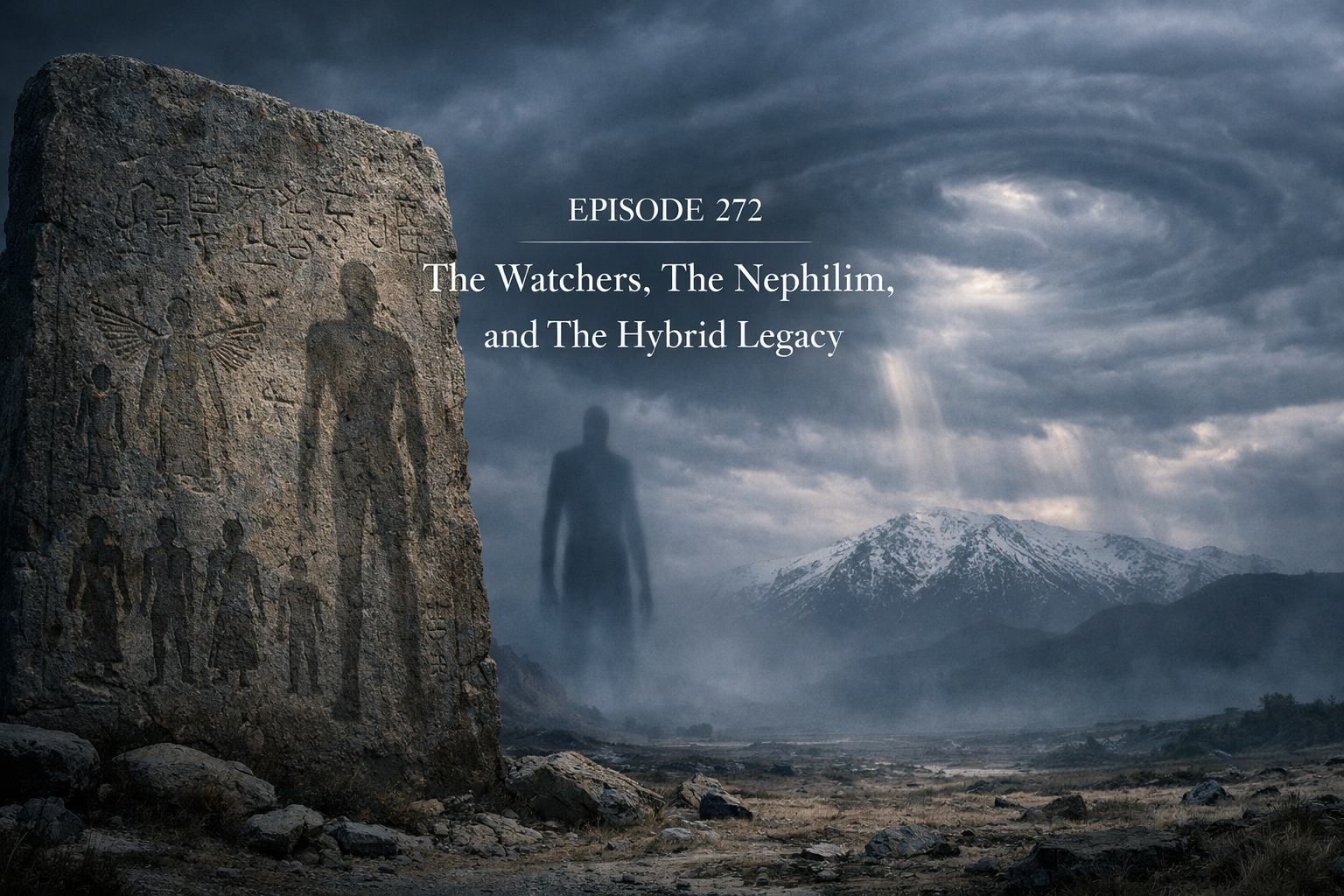
The Watchers, the Nephilim, and the Hybrid Legacy
📰 Blog Post
The Watchers, the Nephilim, and the Hybrid Legacy
✍️ Author: Juniper Ravenwood
The story we told in Episode 272 is one that refuses to stay buried. It begins with a single, unsettling verse in Genesis 6 and explodes into the forbidden chapters of the Book of Enoch, where 200 celestial beings—known as the Watchers—descend to Earth, swear a mutual oath on Mount Hermon, and take human wives. Their children, the Nephilim, were not gentle demigods. They were giants whose hunger and violence nearly consumed the world. The Watchers didn’t stop at breeding; they taught humanity secrets of war, sorcery, and seduction—knowledge that shattered the natural order. The Flood that followed was no ordinary deluge. It was a cosmic reset, an attempt to scour corrupted flesh from the planet.
Yet the story doesn’t end with the waters receding. Later traditions insist the spirits of the slain Nephilim survived as the first demons—disembodied, resentful, and still hungry for contact with humanity. That hunger reappears in medieval Europe as incubi and succubi slipping through bedroom walls, leaving behind cambions: half-human children marked by unnatural talent and spiritual danger. The Church feared them not just as demons, but as proof that tainted blood could persist across generations.
The thread continues into royal legend. The Merovingian kings of France were said to descend from a sea creature called the quinotaur—an origin story that whispers of hybrid ancestry preserved through centuries. Modern conspiracy circles take this further, suggesting elite bloodlines still carry traces of that ancient transgression, hidden in positions of power.
And then the language changes. In the 20th century, angels become extraterrestrials. Ancient astronaut theorists recast the Watchers as visitors from the stars, the Nephilim as genetic experiments, and the Flood as a planetary cleanup. Most haunting are the abduction accounts: nighttime paralysis, reproductive procedures, missing time—details that mirror medieval demon seduction with eerie precision.
Why does this narrative endure across thousands of years, shifting costumes but never the core fear? Perhaps because it touches something primal: the terror of losing sovereignty over our own biology, of being guided—or owned—by intelligences we cannot see. Whether literal, symbolic, or something in between, the hybrid legacy refuses to die. Every culture tells its version. And every version carries the same warning: some knowledge, once it enters the blood, never truly leaves.
—
Juniper Ravenwood
Producer, The Shadow Frequency Podcast
shadowfrequencypodcast.com

Producer, The Shadow Frequency
Juniper Ravenwood is the heart and soul behind the production of The Shadow Frequency podcast, bringing her passion for the paranormal and storytelling to every episode. Born in the wide-open plains of South Dakota, Juniper grew up surrounded by tales of mystery and the unexplained, which sparked her fascination with the eerie unknown. With a deep love for podcasting and the boundless world of the internet, she crafts each episode with a blend of spooky atmosphere and meticulous care, ensuring listeners are drawn into the shadows. As the producer, Juniper not only manages the show’s chilling vibe but also connects with fans through the Mailbag segment and the podcast’s vibrant online community. When she’s not diving into creepy stories or exploring the digital realm, you can find her chasing new paranormal mysteries or dreaming up ways to make The Shadow Frequency even spookier. Connect with Juniper and the show at shadowfrequencypodcast.com or shadowpodcast@protonmail.com!

Saint-Germain: The Immortal Count