Dead Links and Dark Signals
Dead Links and Dark Signals: When Internet Horror Feels Like Evidence 💻📼🌙
author juniper ravenwood
The Screen as a Haunted Doorway 👁️🗨️
There was a time when the scariest stories lived in old houses, empty roads, and dark woods. Now they live in tabs, uploads, archived threads, and strange files that seem to appear from nowhere. That’s what makes the subject of Episode 327 of The Shadow Frequency so unnerving. These aren’t just creepy videos or odd web stories you can shrug off and move on from. These are cases that spread because they feel like something more — like evidence, like artifacts, like messages that shouldn’t have arrived where they did.
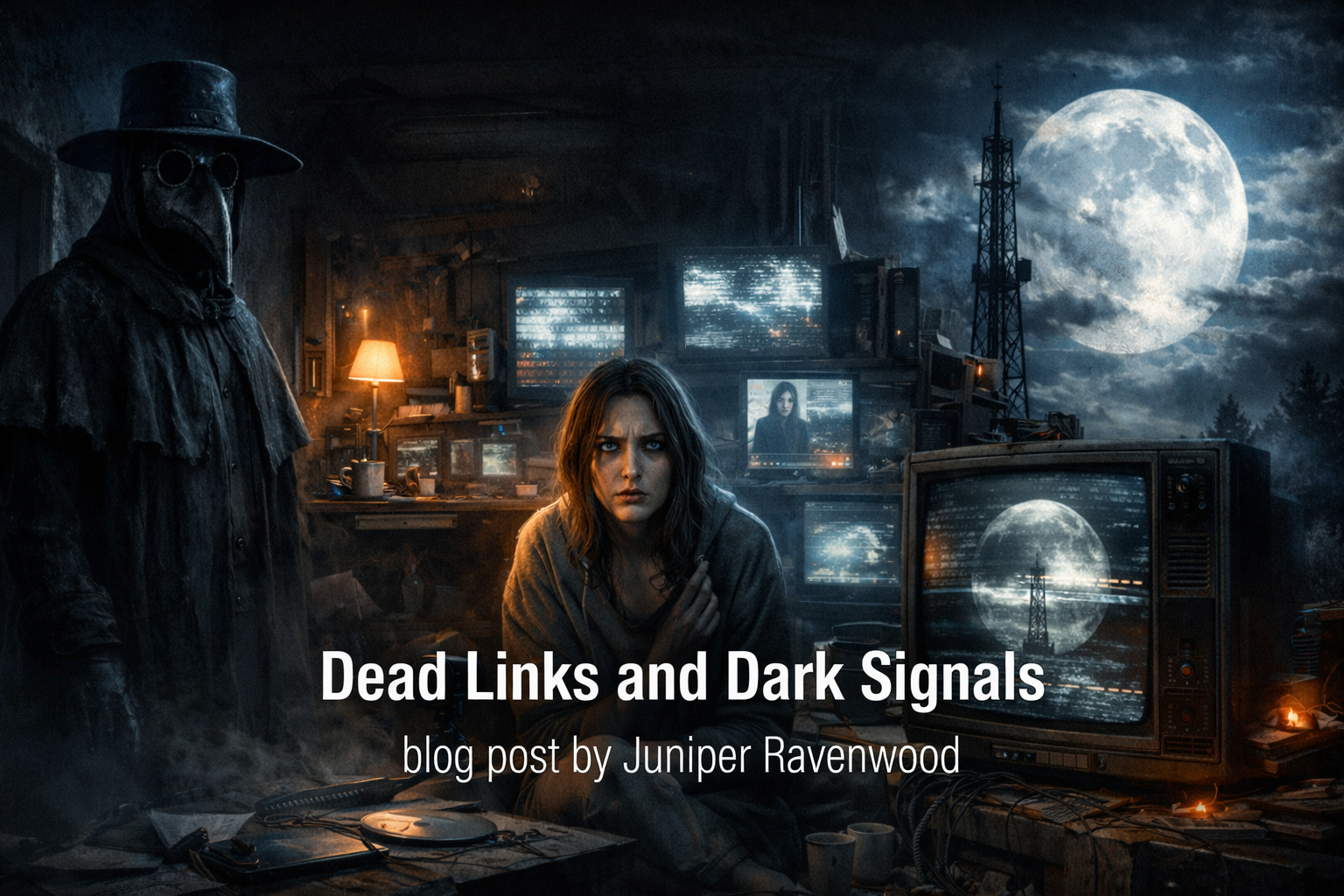
In this episode, we explore three of the internet’s most unsettling modern legends: the plague doctor DVD mailed to Sweden, the Seoul livestream known for its deeply disturbing around-the-clock broadcast, and the eerie moon-warning signal tied to late-night television dread. On the surface, they seem very different. But underneath, they all strike the same nerve: the fear that technology doesn’t just show us horror anymore — it can carry it.
The Horror of the Plague Doctor DVD 📀🕯️
The first case feels like something passed hand to hand in secret. A DVD appears in Sweden with no return address. On it is footage of a plague doctor figure inside an abandoned institutional setting, presented in such a strange and deliberate way that viewers immediately felt there had to be more hidden beneath the surface. And there was. Online investigators began pulling apart the audio, studying symbols, and extracting hidden material tucked into the sound itself.
That’s the kind of horror that gets under your skin because it behaves like a puzzle box. You don’t just watch it. You handle it mentally. You decode it. You go back. You compare notes. The fear isn’t only in the image of the plague doctor. It’s in the possibility that the message was built to be discovered piece by piece, and that by engaging with it, you become part of the thing it was designed to do.
The Seoul Livestream and the Fear of Watching 📹🛏️
The second case is different — and maybe even more brutal. Here, the horror is not hidden in symbols or sound frequencies. It unfolds in plain view. A woman livestreams herself constantly from a cluttered apartment, insisting she has been implanted with a chip and is being manipulated in ways she cannot stop. People tune in. Some out of concern. Some out of morbid fascination. Some because they cannot decide whether what they’re seeing is performance, crisis, delusion, or something worse.
That is where the story becomes truly bleak. The internet gives us a front-row seat to human unraveling, but it does not guarantee compassion, action, or help. It turns viewers into witnesses, and sometimes witnesses into spectators. That’s part of what made this case spread the way it did. It left people with an awful question that still hangs there: what does it mean when thousands are watching and nobody really knows how — or whether — to intervene?
The Moon Signal and Corrupted Authority 🌕📺
Then comes the moon-warning signal, which taps into another primal fear entirely: the fear of trusted systems turning hostile. A local-TV style broadcast begins speaking in a voice viewers were never meant to hear, warning them not to look at the moon. Then, just as the warning settles in, the message changes. Suddenly the signal itself seems unstable, compromised, split between one instruction and another.
This kind of horror works because it feels familiar before it becomes impossible. Public access. Emergency messaging. Local channels. These are ordinary things. Domestic things. Safe things. Until they aren’t. And that moment — the moment trust breaks — is where signal horror thrives.
Why These Stories Endure 🌐🧠
What keeps stories like these alive is not just that they are creepy. It is that they demand participation. People don’t simply hear them and move on. They replay them, archive them, theorize about them, and share them. They become collaborators in the folklore. In older times, strange stories spread from whisper to whisper. Now they move from screen to screen, carried by curiosity, dread, and the need to know whether the impossible thing felt real to somebody else too.
That is the beating heart of this episode. Internet horror endures because it mirrors modern fear so perfectly: contamination through media, neglect in public view, and the terrifying idea that a signal can change without warning. These stories may live online, but the fears inside them are ancient.
Final Thoughts from the Static 🖤📡
What fascinates me most about these cases is that they sit in that perfect Shadow Frequency space — half folklore, half artifact, half performance, half possible truth. They remind us that the supernatural does not always arrive in a cemetery or a crumbling mansion. Sometimes it arrives in your mailbox. Sometimes it appears in a webcam frame. Sometimes it flickers across the television and asks you not to look outside.
And once you’ve seen it, it gets a little harder to pretend the screen is empty.
— Juniper Ravenwood

Producer, The Shadow Frequency
Juniper Ravenwood is the heart and soul behind the production of The Shadow Frequency podcast, bringing her passion for the paranormal and storytelling to every episode. Born in the wide-open plains of South Dakota, Juniper grew up surrounded by tales of mystery and the unexplained, which sparked her fascination with the eerie unknown. With a deep love for podcasting and the boundless world of the internet, she crafts each episode with a blend of spooky atmosphere and meticulous care, ensuring listeners are drawn into the shadows. As the producer, Juniper not only manages the show’s chilling vibe but also connects with fans through the Mailbag segment and the podcast’s vibrant online community. When she’s not diving into creepy stories or exploring the digital realm, you can find her chasing new paranormal mysteries or dreaming up ways to make The Shadow Frequency even spookier. Connect with Juniper and the show at shadowfrequencypodcast.com or shadowpodcast@protonmail.com!
Lost Cities Beneath the Amazon Canopy


 RSS Feed