Alien Frogmen of Aveley
👽 A Strange Night Over Aveley
Some paranormal stories feel polished by time. Others feel jagged — like a piece of something older and stranger that never fit neatly into any category. The 1956 Aveley case belongs in that second group.
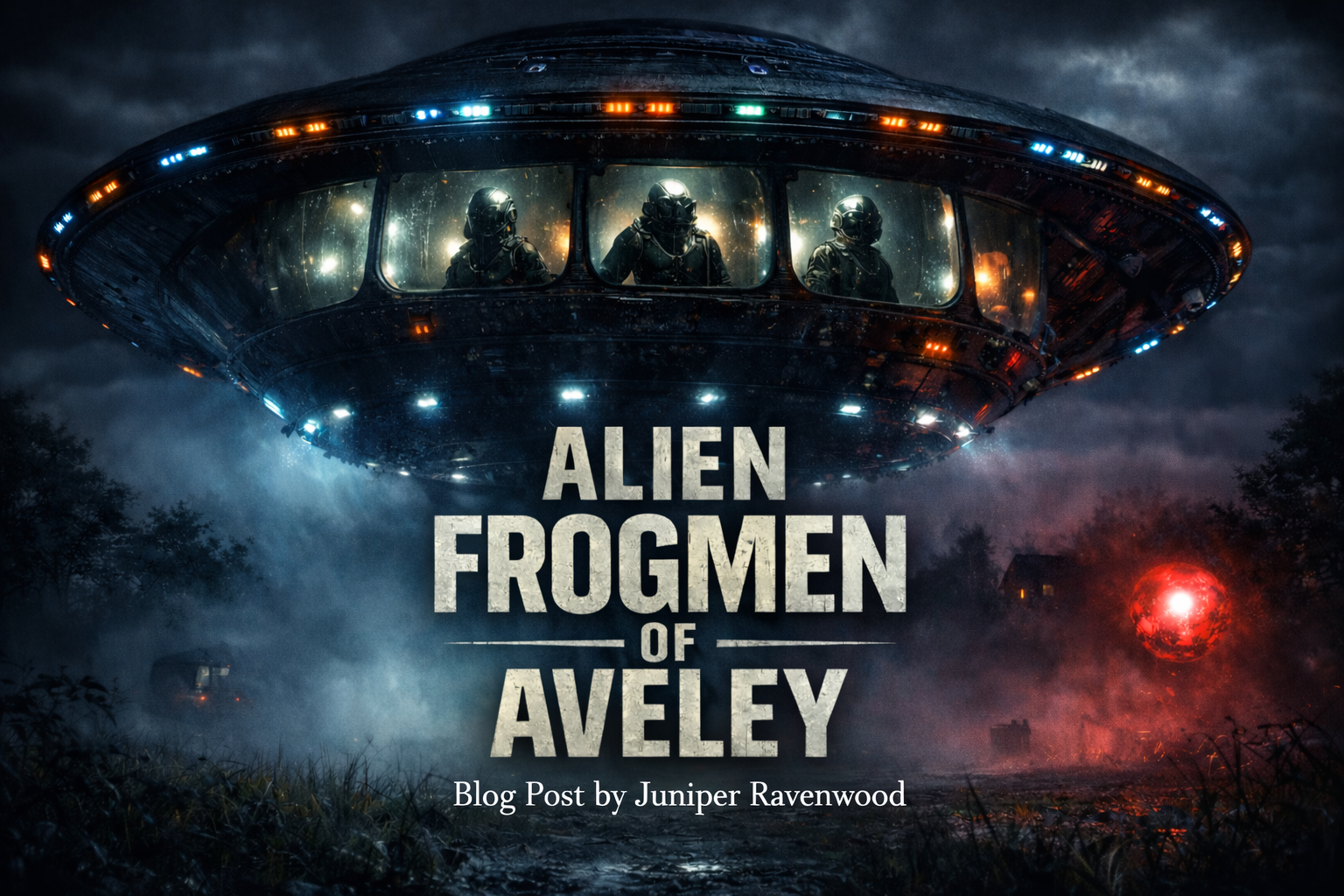
Set in Aveley, Essex, this story reaches us through later UFO literature rather than a thick stack of contemporary newspaper coverage or official investigation files. That alone gives it a ghostly quality. It survives not as a fully documented “classic,” but as a vivid account passed forward because the images in it are simply too odd to forget. Later summaries describe a teenage witness waking to an orange-yellow glow on his ceiling, looking out into the dark, and seeing a silent craft lit by rotating lights and lined with glowing windows. Through those windows, he reportedly saw figures moving around inside — figures he described as looking like frogmen.
🌌 Why the “Frogmen” Detail Matters
That one detail is what gives the case its staying power.
This was not the now-familiar alien image that later dominated pop culture. No neat little Grey archetype. No tidy science-fiction shorthand. Instead, the witness reached for a comparison that felt grounded in his own world: frogmen, divers, figures in dark suits. That makes the account feel older and less standardized. Whether you view that as evidence of authenticity, memory under stress, or folklore in motion, it is undeniably specific. And specificity is often what keeps a strange story alive.
The reported craft itself also adds to the unease. This was not just a distant light in the sky. Later retellings describe windows, structure, interior light, and movement within. That shifts the story from a simple sighting into something more intimate — almost invasive. A witness is no longer observing a mystery from afar. He is, in effect, looking into it. And the possibility that something might also have been nearer the house than he realized only sharpens the fear.
🏚️ Aveley, Belhus, and the Atmosphere of Place
Place matters in stories like this.
Aveley in the mid-1950s sat on an edge — rural enough to feel exposed, old enough to carry history, and close enough to London to feel like the known world was pressing up against older ground. The nearby Belhus estate had deep roots in the area, and the great house itself did not survive intact into the modern era, eventually being demolished after wartime damage and decline. That does not prove anything paranormal, of course, but it does help explain why the setting feels so potent in retrospect: open land, scattered homes, old estate ground, and darkness that was probably much deeper than what we imagine today.
📁 Why the Record Feels So Fragmentary
One reason older British UFO cases can feel frustratingly incomplete is that many of them are.
The National Archives explains that while British official reporting and analysis of UFO sightings began in the early 1950s, substantial surviving records begin in 1962. Before that, Ministry of Defence policy often treated UFO files as being of only “transitory interest,” and many earlier records were destroyed at five-year intervals. That does not validate every old sighting, but it does explain why a story like Aveley can have such a strange documentary shape: memorable enough to survive in later journals and retellings, but lacking the kind of preserved file modern readers expect.
🔴 The Red Orb and the Lingering Question
And then there is the second event.
What elevates the case beyond a single witness looking out a bedroom window is the later report that his mother, hours afterward, saw a glowing red sphere moving toward the house. If that detail is remembered correctly, it changes the emotional structure of the story. Now the strange event is not over when the craft departs. Now it feels as if something returned — or something separate arrived. That unresolved question is exactly what makes the Aveley case so effective as paranormal storytelling. One event or two? Misperception or genuine anomaly? Memory shaping myth, or myth preserving a real brush with the unknown?
That is why the Alien Frogmen of Aveley endure. Not because the case proves extraterrestrials beyond doubt, but because it leaves behind a set of images that are hard to shake: a glowing ceiling, lit windows in the dark, strange figures moving inside, and a red sphere drifting toward a house that had already seen too much. Some stories survive because they are famous. Others survive because they are too weird to die.
— Juniper Ravenwood

Producer, The Shadow Frequency
Juniper Ravenwood is the heart and soul behind the production of The Shadow Frequency podcast, bringing her passion for the paranormal and storytelling to every episode. Born in the wide-open plains of South Dakota, Juniper grew up surrounded by tales of mystery and the unexplained, which sparked her fascination with the eerie unknown. With a deep love for podcasting and the boundless world of the internet, she crafts each episode with a blend of spooky atmosphere and meticulous care, ensuring listeners are drawn into the shadows. As the producer, Juniper not only manages the show’s chilling vibe but also connects with fans through the Mailbag segment and the podcast’s vibrant online community. When she’s not diving into creepy stories or exploring the digital realm, you can find her chasing new paranormal mysteries or dreaming up ways to make The Shadow Frequency even spookier. Connect with Juniper and the show at shadowfrequencypodcast.com or shadowpodcast@protonmail.com!
Lost Cities Beneath the Amazon Canopy


 RSS Feed