Blog Post: Exploring the Vampire Plague of 1730s Europe and Its Unearthly Connections
By Juniper Ravenwood
🧛♀️ A Haunting Past
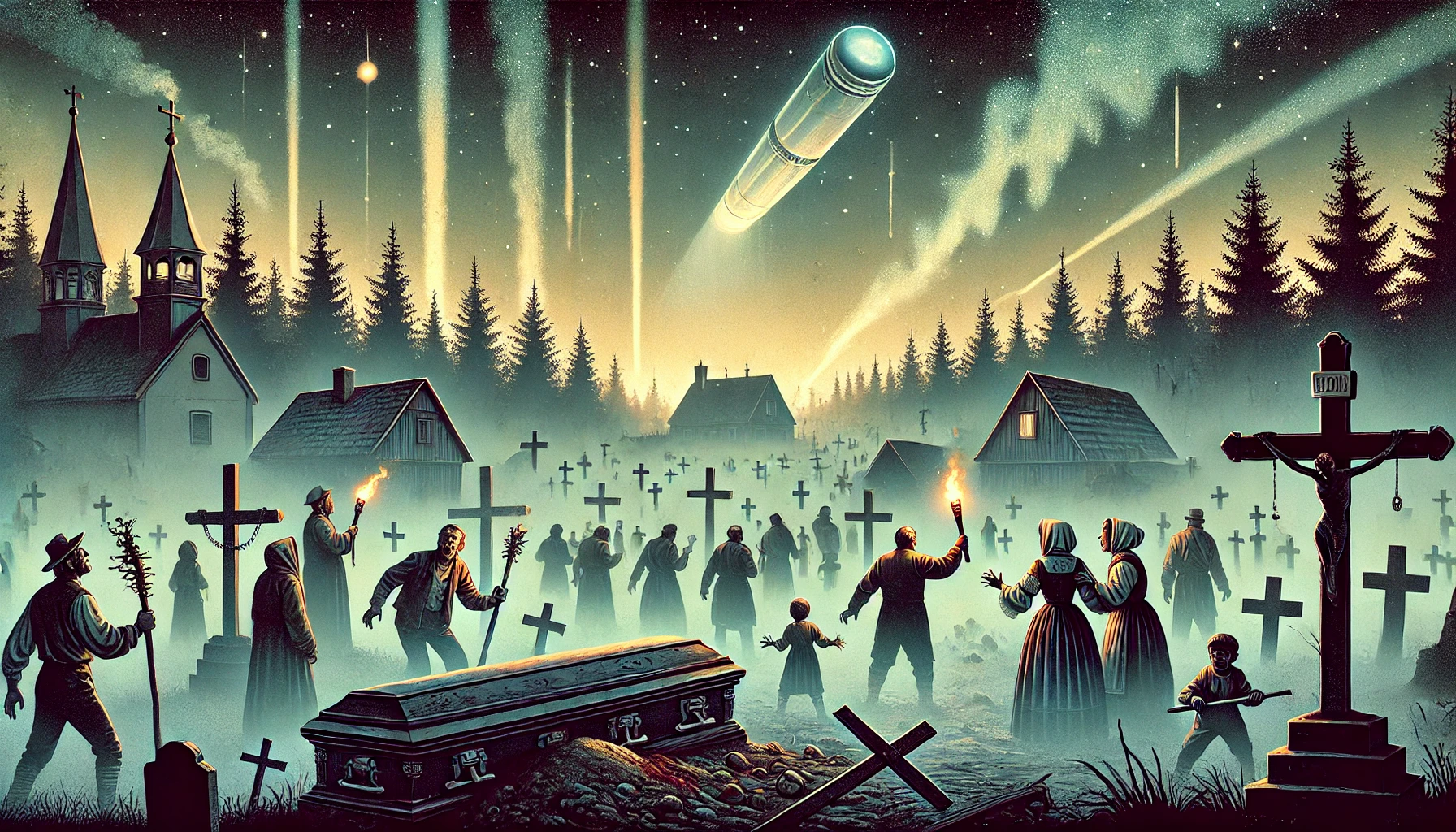
In the 1730s, the villages of Eastern Europe were gripped by a terror that feels like it was ripped from a gothic novel 📖🕸️. The vampire panics, particularly in Serbia 🇷🇸, saw communities digging up graves, staking corpses, and burning bodies 🔥 in a desperate attempt to stop what they believed were the undead. Cases like Petar Blagojevich, whose exhumed body was said to be unnervingly fresh with blood at his lips 🩸, and Arnold Paole, linked to a wave of mysterious deaths ☠️, fueled a hysteria that spread like wildfire 🔥. These weren’t just ghost stories—they were real, visceral fears rooted in a time when death was a mystery ⚰️, and science hadn’t yet explained the gruesome realities of decomposition 🦠.
🧟♂️ The Vampire Panic Unveiled
Imagine a foggy Serbian village, 1731 🌫️🏡. A family buries a loved one, only to fall ill days later, wasting away with pale skin and sunken eyes 😨. Whispers spread: the dead are walking. Villagers gather at midnight, shovels in hand, unearthing a corpse that looks oddly alive—bloated, with blood at the mouth, nails still growing 💅🧛♂️. To them, this wasn’t natural decay; it was proof of vampirism. Diseases like tuberculosis, which caused victims to look drained and ghostly 😵, only deepened the panic. Without germ theory 🧫, folklore filled the gaps, painting the dead as predators. The stakes, the fires, the rituals—it was all a desperate bid to reclaim safety from the unknown 🔥🪓.
👽 An Extraterrestrial Twist
Fast forward to the 20th century, and a wild theory emerges: what if these vampire panics weren’t just superstition? Fringe researchers, like Gianfranco degli Esposti, have pointed to historical accounts of strange aerial phenomena—cigar-shaped objects or glowing mists 🚬☁️—linked to epidemics like the Black Death. Could something similar have happened in the 1730s, unnoticed or unrecorded amid the chaos? The extraterrestrial hypothesis (ETH) suggests that unidentified aerial phenomena might be tied to advanced beings, possibly experimenting on human populations 👾🧬. The idea is chilling: what if the “vampires” were a misinterpretation of alien influence, their mists or technologies causing the illnesses blamed on the undead? 🌌
🧠 Skepticism in the Shadows
As much as I love a good paranormal theory, there’s another side to consider. The 1730s were a time of limited medical knowledge 🧪. Decomposition was misunderstood—bloating and blood pooling were natural but looked supernatural 🫣. Diseases like tuberculosis perfectly mimicked vampiric symptoms. The UFO angle, while tantalizing, lacks concrete evidence from the period 📜. No records of strange lights or objects exist alongside the vampire panics, and the extraterrestrial theory leans heavily on speculation 🛑. It’s possible the hysteria was entirely earthly, born from fear and ignorance rather than visitors from the stars 🌍.
🌘 Why It Still Haunts Us
Whether you lean toward vampires or aliens, the 1730s vampire plagues reveal something timeless ⌛: our need to explain the unexplainable. When faced with mystery, we craft stories—whether it’s undead creatures or extraterrestrial experiments 📚👀. These tales, rooted in real fear, remind us how the unknown can shape entire communities. So, the next time you’re out at night, glance at the sky 🌌. Is it just stars up there… or something watching, waiting, ready to spark the next panic? 👁️🛸
Signed,
Juniper Ravenwood

Producer, The Shadow Frequency
Juniper Ravenwood is the heart and soul behind the production of The Shadow Frequency podcast, bringing her passion for the paranormal and storytelling to every episode. Born in the wide-open plains of South Dakota, Juniper grew up surrounded by tales of mystery and the unexplained, which sparked her fascination with the eerie unknown. With a deep love for podcasting and the boundless world of the internet, she crafts each episode with a blend of spooky atmosphere and meticulous care, ensuring listeners are drawn into the shadows. As the producer, Juniper not only manages the show’s chilling vibe but also connects with fans through the Mailbag segment and the podcast’s vibrant online community. When she’s not diving into creepy stories or exploring the digital realm, you can find her chasing new paranormal mysteries or dreaming up ways to make The Shadow Frequency even spookier. Connect with Juniper and the show at shadowfrequencypodcast.com or shadowpodcast@protonmail.com!
Lost Cities Beneath the Amazon Canopy


 RSS Feed